


Table of Contents
- Introduction
- Understanding the Total Cost of Accounting Software Implementation
- Setup and Configuration: Foundation Costs
- Integration Costs: Connecting Financial Systems
- Training Costs: Ensuring Effective Adoption
- Final Thoughts: Planning for Long-Term Value
- How Atidiv Helps Strategize Your Accounting Processes
- Accounting Software Implementation FAQs
Accounting software implementation is no longer just a technology decision; rather, it is a strategic investment that directly impacts financial accuracy, compliance, and operational efficiency. While subscription pricing is often the most visible cost, the true expense of accounting software implementation extends far beyond monthly fees. Businesses must account for several costs – from setup and system integration to data migration and employee training to understand the full financial picture.
Introduction
As businesses scale, financial operations become more complex, transaction volumes increase, and compliance requirements tighten. Manual bookkeeping methods and fragmented financial tools that once worked for small teams often fail to provide the accuracy of data pulling and the control derived from financial visibility. For these reasons, AI has been implemented for automating F&A functions, with 49% business leaders opting for it in 2025, a jump from 23% in 2024!
At this point, accounting software implementation becomes not just a convenience but a necessity for maintaining financial discipline and operational stability. However, it is important to understand the costs that come with implementing accounting software so that you can plan strategically for the transition process.
Understanding the Total Cost of Accounting Software Implementation
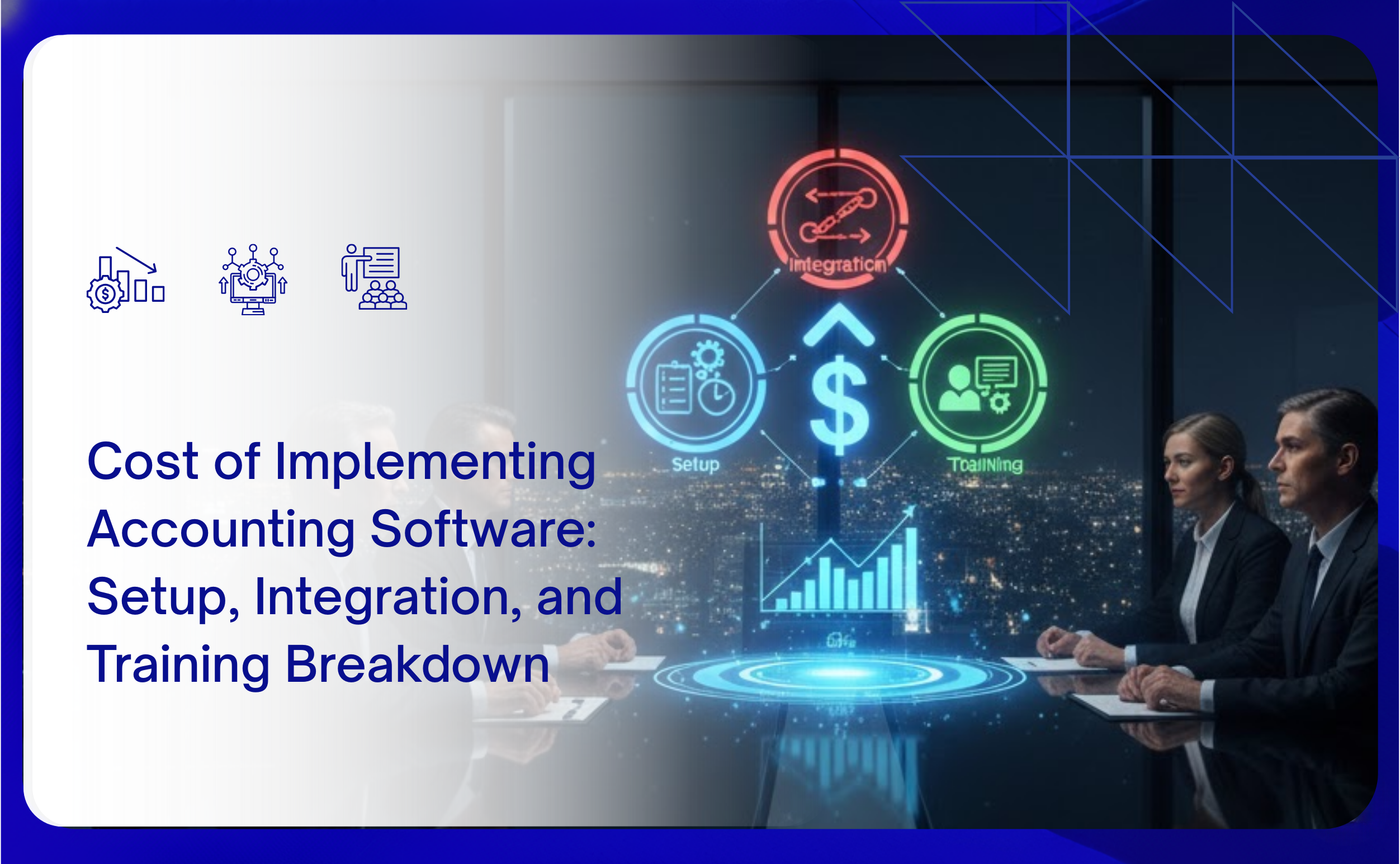
The total implementation cost typically includes three major components:
- Setup and configuration
- Integration with existing systems
- Training and change management
Depending on business size, industry complexity, and automation goals, implementation costs can range from a few thousand dollars for small businesses to six figures for mid-sized and enterprise organizations.
Setup and Configuration: Foundation Costs
Let us now try to understand the different components of accounting software setup:
- Licensing and subscription: This is the initial and thus the most important step that you should not slack off on. While the minimum subscription costs start at USD 13 per month, a plan suitable for basic cloud-based accounting needs, the maximum subscription cost can reach USD 500 per user per month or more! This wide range reflects how pricing scales with features, deployment model, and business complexity.
- System configuration: In this phase, you will evaluate which software best aligns with the existing operational software your business already uses. During the initial configuration phase, the accounting software is structured through the chart of accounts setup –
- tax rules and compliance settings,
- fiscal calendar configuration, and
- currency and localization setup.
Thus, the entire logical framework that defines your F&A functions is built. The costs at this touchpoint could vary between USD 500 and USD 5000, depending on the customization complexity.
- Data migration: Migrating historical financial data from spreadsheets or legacy systems is one of the most time-consuming steps, and it involves the following functions –
- Cleaning and validating existing data
- Mapping old data fields to the new system
- Importing transactions, balances, and vendor/customer records
- Verifying accuracy post-migration
Data management at this stage is extremely important, and accidental skipping of data could affect the bank reconciliation process adversely. The costs you would have to bear at this stage could vary due to a variety of reasons, from format quirks and business logic to complex transformations and the use of data cleaning software.
Keeping everything in mind, you should keep aside about USD 500 – USD 2,000 for simple data migrations. For multi-year data validation, however, costs could rise dramatically (USD 3,000 to USD 10,000).
Integration Costs: Connecting Financial Systems
Integration is the process by which your internal system is linked to the accounting software implementation setup. A fairly technical process, integration could cost you anywhere between USD 1,000 and USD 150,000! Let us take a look at the major integration types and the rationale behind their pricing range.
| Integration Type | Typical Cost Range | Rationale |
| Native Integrations | USD 0 – USD 1,000+ | Built-in connectors provided by accounting software vendors – the lowest-cost option. It could cost you zilch if you manage it by yourself! |
| Standard Third-Party Integrations | USD 5,000 – USD 15,000 | Common ERP, CRM, payroll, or banking integrations using standard workflows – requiring a mid-range budget. |
| Custom Integrations | USD 15,000 – USD 50,000+ | Custom API or middleware development for non-native systems – coming in the higher-end integration budget category. |
| Enterprise API Integrations | USD 50,000 – USD 150,000+ annually | Large-scale integrations require dedicated development, testing, and security controls – total financial sovereignty requiring an extended budget. |
| Ongoing Maintenance | 10–20% of the initial integration cost annually | Covers updates, system changes, monitoring, and performance optimization. |
In 2025, your accounting system must be integrated with your internal business software so that you have total grip over the financial implications of your operations.
Training Costs: Ensuring Effective Adoption
Even the most powerful accounting software fails without proper user adoption. Training costs are often underestimated but are critical for long-term success.
Let us now take a look at the types of training that you need to impart during this change management process:
- Basic navigation and transaction entry
- Month-end and year-end close procedures
- Reporting and dashboard usage
- Compliance and audit workflows
- Automation and approval processes
It must be kept in mind that this workflow is a basic one, and the real employee orientation around automation protocol takes time and needs continuous upgradation. Training needs vary across roles, frombookkeepers and finance managers to executives, all requiring different levels of briefing. Therefore, the hiring process itself could require restructuring, with HR departments selecting candidates with the desired skillset fit for a particular workflow. This fine-tuning of internal teams could flare up costs.
Furthermore, if we look at employee training costs, like course fees and required materials, it could make you poorer by a few thousand USD. However, it is important to note here that you will also have to deal with hidden costs in this phase. These costs include the estimated loss of revenue owing to reduced employee productivity. Estimating around USD 3,000 per employee, accounting for the time employees are away from core work duties, it could substantially increase the overall investment required.
However, you need not worry about employee training when you partner with F&A brands like Atidiv, which ensures employee training for the best business outcomes.
Final Thoughts: Planning for Long-Term Value
Accounting software implementation should be treated as a strategic, long-term investment, not a one-time technology expense. While setup, integration, and training costs may seem substantial upfront, they could very well be the make-or-break deal for your business’s future. Therefore, negotiate well.
These are the key takeaways to consider:
- Setup costs ensure accurate financial structure and compliance from day one.
- Integration costs enable seamless data flow across business systems, improving financial visibility and control.
- Training and change management drive user adoption and prevent productivity losses post-implementation.
- Upfront planning helps avoid costly rework and errors, identifying underutilized software so that its usage can be traded for technology relevant to your work processes.
- Long-term benefits of accounting software include faster closing cycles and improved compliance, both contributing significantly to better decision-making.
Organizations that budget realistically are better positioned to recover implementation costs and achieve sustained efficiency. Therefore, a well-executed accounting software implementation ultimately strengthens your financial governance and supports scalable business growth in 2025.
How Atidiv Helps Strategize Your Accounting Processes
As businesses grow, managing accounting processes internally often becomes fragmented, time-intensive, and difficult to scale without compromising accuracy or compliance.
With 16+ years of experience in finance and accounting services, Atidiv has helped organizations across industries transition from manual, error-prone workflows to technology-driven, automated accounting ecosystems. Delivering 100% accuracy in deliverables like reporting and compliance support has helped us carve a niche!
How Atidiv adds value to your accounting software implementation:
- End-to-end support for accounting setup, integration, and optimization across AP, AR, payroll, and reconciliations
- Expertise in selecting, implementing, and aligning accounting software with existing ERP, CRM, and banking systems
- Automation-first approach to reduce manual effort, close cycles, and operational risk
- Trained finance professionals, ensuring accurate books, audit readiness, and regulatory compliance
- Ongoing support to scale and refine accounting processes as business needs evolve
Ready to implement accounting software without cost overruns or operational disruption?
Connect with Atidiv’s Finance & Accounting experts to build a streamlined, compliant, and future-ready accounting function.
Accounting Software Implementation FAQs
1. Is employee training really necessary if the software is user-friendly?
Yes. Even the most intuitive accounting software requires structured training to ensure accuracy, compliance, and consistent usage. Without proper training, employees may use features incorrectly, bypass controls, or underutilize automation, leading to errors and productivity loss. Training ensures teams understand workflows such as reconciliations and compliance processes, which are critical for long-term success.
2. How can businesses control accounting software implementation costs in 2025?
Businesses can control implementation costs by planning upfront and prioritizing what they actually need. Thus, they can limit unnecessary customizations, use native integrations where possible, and migrate only essential historical data. This phasing of automation over time could help control accounting costs effectively. To take it a notch higher, partnering with experienced F&A providers like Atidiv also helps avoid rework, misconfigurations, and costly post-implementation fixes.
3. Can accounting software implementation disrupt daily operations?
Accounting software implementation can cause short-term disruption if it is rushed or poorly managed, but a phased and well-planned rollout minimizes operational impact. Running parallel systems temporarily and assigning clear ownership for implementation tasks helps ensure business continuity. With expert-led implementation and change management, businesses can transition smoothly without interrupting core operations.