


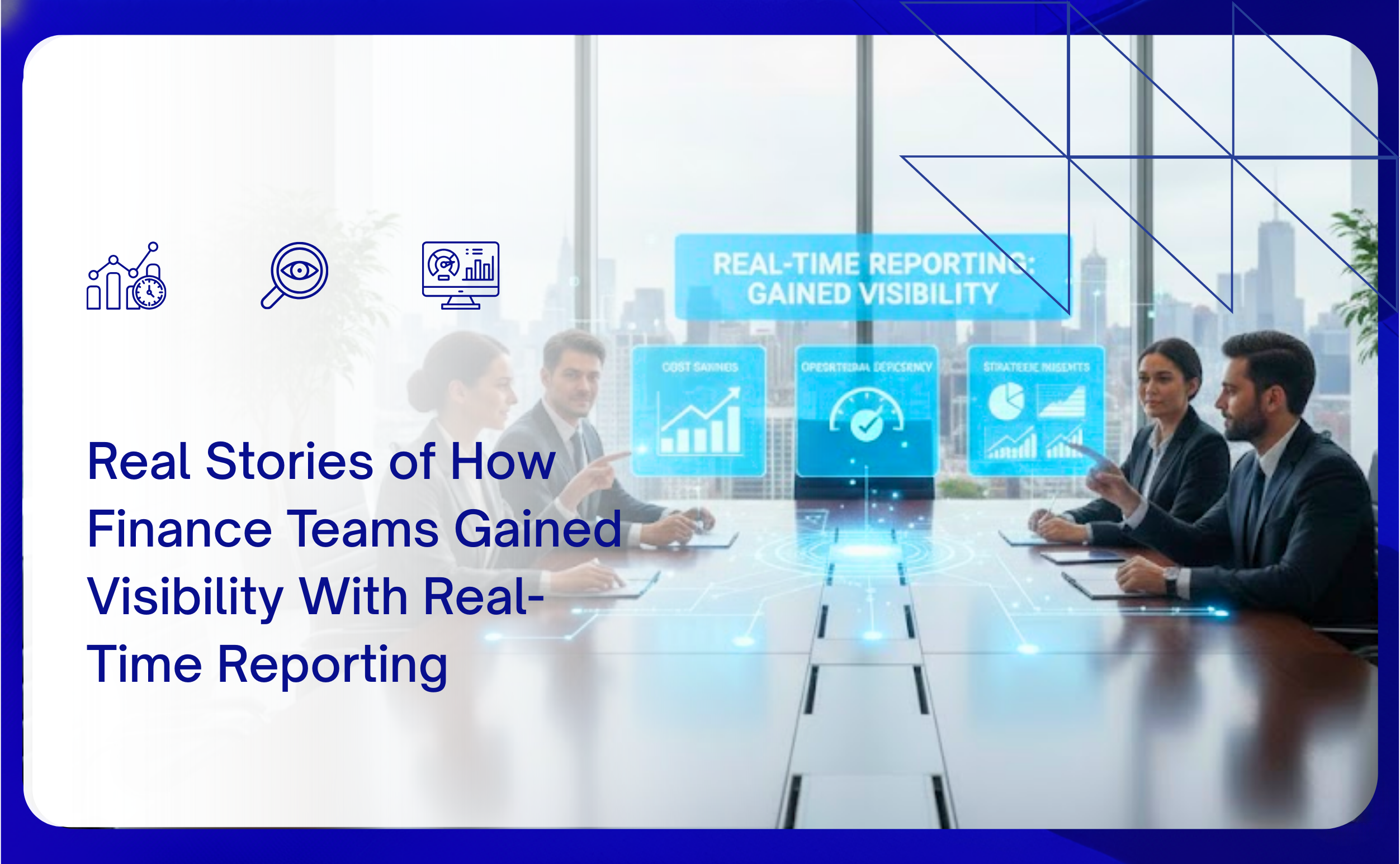
Real-time reporting gives you a “live view” of your financial numbers. It removes delays from manual work or month-end routines and allows the leaders to always see the current financial position. With this visibility, you can spot issues early and make better business decisions using accurate + up-to-date information.
Most finance teams don’t struggle with data. They struggle with timing! When they get delayed financial insights (late by several days or weeks), that is only outdated “information” and not “intelligence”.
The impact? It’s both operational and strategic:
- Decisions become “reactive” as leadership responds to problems after they have already affected cash flow, margins, or project outcomes.
- By the time numbers surface, market conditions, spending patterns, or revenue drivers may have already changed.
- In the month, most teams struggle to reconcile errors, investigate variances, and explain surprises that could have been caught earlier.
- Lack of real-time visibility leads to duplicate spend and revenue leakages.
Don’t want that? That’s why several D2C companies and consumer brands have opted for “real-time reporting” in 2025. It shifts finance from a retrospective function to a continuous decision engine.
Want to learn how? Read this article to first understand what real-time reporting is and then see six real stories of companies benefitting from it.
What is Real-Time Reporting in Finance?
Real-time reporting in finance lets you see updated “financial numbers” the moment a transaction happens. You don’t have to wait until the end of the week or month. The financial data is updated instantly when your staff:
- Buys something
- Approves an invoice
- Sends a payment
- Updates inventory
As a result, you don’t wait for manual updates or month-end reconciliations. You always have a “live view” of cash, expenses, revenue, budgets, and project costs.
Okay, Any Advantages?
Yes, real-time reporting allows you to:
- Know your true cash position “right now” (not last week’s balance).
- Spot unusual spending before it becomes a bigger issue.
- Better control budgets and costs because you see the cash flow movement daily.
- Avoid last-minute month-end surprises, as most problems appear in real-time and not during close.
Studies show that companies adopting real-time reporting in finance have achieved 40% faster decision-making, with 72% of CFOs viewing tech investments for better data as highly important.
How Real-Time Financial Reporting Removes Blind Spots? 6 Real Case Studies 2025!
Research found that about 55% of CFOs, before using real-time reporting, lacked “strategic visibility.” They could not clearly see how their company’s financial results connected to the overall business strategy. Why? They were usually working with:
- Delayed numbers
- Scattered reports
- Manual spreadsheets
All these made it hard to understand cash flow, budget gaps, or how different departments were performing. But after switching to “instant dashboards” with real-time reporting data, these visibility gaps disappeared. CFOs could immediately view:
- Cash positions
- Spending patterns
- Variances
This gave them a 100% clearer link between daily financial activity and long-term strategy. For more clarity, check out these six case studies showing how different businesses gained from real-time reporting in finance:
1. The Teampay Story
Many companies do not know how money is being spent until the monthly credit card bill arrives. Peter Nesbitt, former VP of Finance at Teampay, said – This made teams ‘fly blind’ for most of the month because they:
- First, waited for statements
and
- Then rushed to resolve surprises like unplanned software purchases or suspicious charges.
Now, real-time reporting has changed this. The team could get real-time spending data, which made them see purchases the moment they happened. This allowed them to:
- Stop duplicate software subscriptions
- Catch fraud at the start
- Prevent waste when employees in different locations use company cards
It also helped during unpredictable economic periods. Instead of relying on old numbers, Teampay could update forecasts using current spending, which reduced financial risk.
2. The Bravedo Case
Bravedo managed more than 100 business entities, each with its own bank accounts and payment tools. Their treasury team spent hours every day:
- Collecting numbers
- Preparing reports
- Tracking bank activity
This made decision-making slow because the data was always outdated by the time it reached leadership. By switching to real-time reporting, Bravedo pulled all entities, accounts, and transactions into one real-time dashboard.
The immediate impact? Daily reporting that used to take hours took only minutes! Teams could access transaction-level bank data 4X faster. This removed the need for older payment systems and gave leaders a live view of cash, payments, and balances across the entire group.
3. The Deloitte Example
Deloitte was struggling because most financial information appeared only at the end of the month. Teams waited for the final close to understand:
- Sales
- Spending
- Operational trends
By moving to cloud dashboards and continuous accounting, every department started viewing live financial data throughout the month. Process owners could see the exact transactions behind their numbers, which improved the accuracy of reports across the company.
Leadership also gained predictive insights, which allowed them to spot new opportunities (such as blockchain use cases). In this way, real-time reporting:
- Reduced dependence on month-end reports
and
- Created a culture where decisions were made using current financial information rather than outdated summaries.
4. A Leading Construction Firm
CFOs in construction often rely on spreadsheets + manual reconciliations before board meetings or project updates. This created delays and blind spots, particularly when tracking:
- Cash flow
- Project budgets
- Spending across different sites
Later, by switching to real-time reporting, CFOs gained instant views of cash positions, budget variances, and department-level spending on one dashboard. The positives?
- Real-time inventory tracking allowed them to control material costs and avoid stock issues.
- Operations teams also saw immediate changes because they could connect actions on the ground with their financial impact.
5. The Awardco Example
Awardco struggled with errors, miscodings, and adjustments that always showed up at the end of the month. FP&A had to resolve these issues after closing the books, which created stress and delayed reporting.
But later, the organisation started using a real-time reporting system. The organization began catching problems at the moment they occurred. Wrong entries, missing accruals, and unusual transactions were flagged immediately. As a result, teams could correct them during the month rather than after the close.
Additionally, they even used “rolling accrual matching” and “real-time reversals”, which kept the books accurate day by day. This saved the finance team more than four full working days each month and improved their closing speed by 33%.
More importantly, it moved the company from “reactive month-end work” to a “proactive process” where most of the closings happened automatically and without last-minute surprises.
6. The 15Five Example
15Five wanted to reduce the heavy workload that always piled up at the end of the month. One major pain point was “prepaid amortization”, which they handled in large batches only during the close. This created delays and forced the team to investigate new items when time was already tight.
Later, they switched to a real-time reporting system and shifted from:
- Monthly batch work
to
- Weekly automated updates
The advantages? New prepaid items were identified instantly and processed during the month instead of waiting for the close. This change saved at least three full business days from their monthly close and improved the accuracy of their numbers throughout the month.
Want to Set Up a Real-Time Reporting System in 2025? Atidiv Can Help You!
So now you know real-time reporting is the ability to see your financial data the moment a transaction happens, instead of waiting for month-end or manual updates. It gives you a live view of cash flow, spending, revenue, and variances.
Some key benefits several companies across the globe have realized are:
- Immediate visibility into cash flow and budgets
- Faster detection of unusual or duplicate spending
- 100% clear insight into department or project performance
- Fewer month-end surprises + smoother closes
If you are looking to set up a real-time reporting system for your business, you can hire Atidiv in 2025. We are an accounting outsourcing company with 16+ years of experience and a network of 390,000+ Chartered Accountants and CPAs.
Our expert team maintains a 95% client retention ratio and delivers services with 100% accuracy. Recently, we partnered with a NYC-based startup and delivered 80% time savings and 50% cost reduction. To learn how we can assist you, book a free consultation call today.
Real-Time Reporting FAQs
1. Why do D2C companies struggle to see accurate financial numbers during the month?
Most consumer brands depend on:
- Manual spreadsheets
- Delayed approvals
- Month-end reconciliations
This creates “blind spots” in cash flow, expenses, and project costs. Now, real-time reporting removes these gaps by updating numbers instantly as transactions occur. This allows VPs or directors of D2C companies to make decisions without waiting for the close.
2. How does automation + AI improve real-time reporting in 2025?
Studies show that in real-time reporting:
- Automation cuts reporting time by 30% and increases accuracy by 25%.
- Whereas, artificial intelligence (AI) reduces data collection work by up to 50% and lowers reporting errors by 90%.
Together, they keep your numbers updated in real-time and reduce manual effort.
3. How does real-time reporting reduce my month-end stress?
Continuous close methods monitor transactions throughout the month instead of during the final week. This improves closing speed by 33 to 40% and saves 3 to 4 business days monthly.
The best part? Errors are fixed immediately, not after the close, which reduces pressure and creates smoother reporting cycles.
4. Will real-time reporting help with compliance, audits, and investor trust?
Yes! Due to real-time reporting, most errors are flagged and corrected instantly, which strengthens compliance. Also, trends become easier to detect because data stays current.
Nowadays, several companies are even using “blockchain-based systems”, which is accelerating audit processes by up to 30% faster.
Together, these increase transparency and improve investor confidence in your financial reporting.
5. What are the top KPIs for real-time financial reporting?
You can start tracking several “close process KPIs”, such as:
- Time to Close: It measures how long it takes to produce financial statements, with modern targets often under five days.
- On-Time Reconciliations: It tracks how many balance sheet items are reconciled before the deadline, showing where delays exist.
- Close Quality: It combines speed, cost, and P&L accuracy to show how strong your end-to-end Record-to-Report (R2R) process is.
These real-time close KPIs allow you to track the speed and accuracy of your reporting cycle.
6. What are the best tools to automate KPI tracking and real-time alerts?
As a senior manager of a D2C company, you may start using tools like Databox, Klipfolio, and Geckoboard. They pull data from 100+ sources and update dashboards the moment new transactions appear. Also, they send instant alerts to email, Slack, or mobile when a KPI drifts off target.
Alternatively, if you prefer a fully managed setup, you can outsource your accounting function to Atidiv and let expert CPAs start working on your project from Day 1. Our services start at only $15 per hour. Book a free call to learn more.