


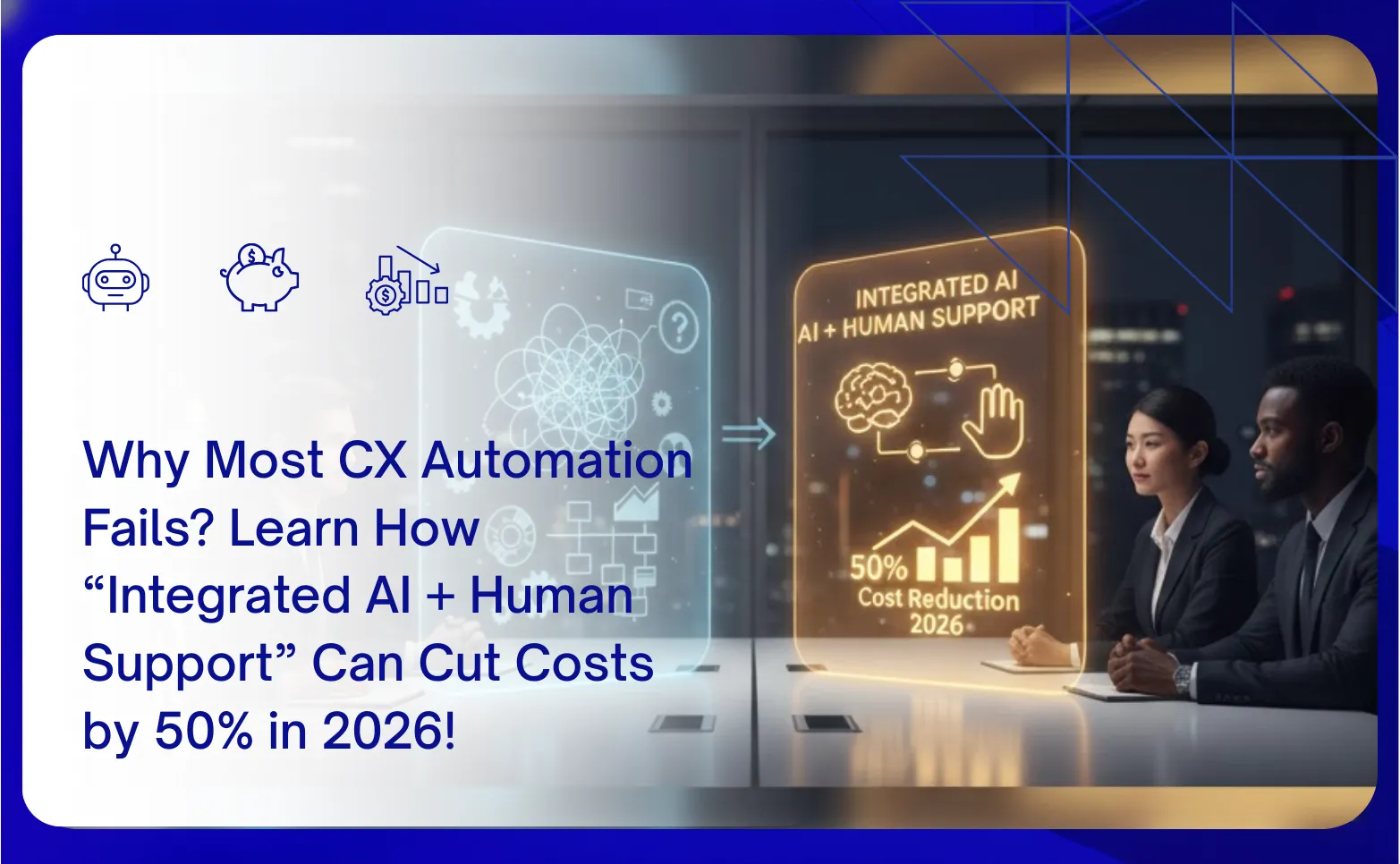
An AI + human-in-the-loop CX model combines automation and human expertise to manage customer support. AI handles routine and repetitive queries, while human agents step in to resolve complex or sensitive issues. This collaborative approach reduces customer response time, improves accuracy, and cuts operational costs.
After the AI boom, several small and mid-sized businesses adopted AI tools to automate customer support. A 2023 Gartner study found that about 80% of companies started using AI to enhance customer experience. The promise was compelling!
- Lower costs
- Faster responses
- Easy scalability without any need to constantly hire new agents.
But in reality, most CX automation efforts failed to deliver real savings! Nowadays, most brands struggle to sustain even 30% automation. A Gartner study shows a major gap between the promise and reality of customer support automation. Among 5,728 customers surveyed, only 14% said their issues were fully resolved through self-service channels, such as chatbots or help centers.
But why is this happening? The problem is not the technology itself! Most automation efforts fail because AI is treated as a “one-time implementation”. Businesses expect them to work indefinitely without any training. At the same time, there is no properly “trained human layer” to support the AI.
The sorry result? Poor customer experience (CX). So, what’s the solution? Several businesses have now started using an “Integrated AI + Human CX” model. Read this article to learn what this model is and how Atidiv can set it up for you in 2026. But first, let’s see why CX automation could not hold onto its promise.
Why Did CX Automation Fail to Deliver? 3 Major Reasons You Must Know in 2026
To achieve the benefits of customer experience automation, many businesses invested in chatbots, AI tools, and automation platforms. However, most companies soon realized that automation alone does not solve the problem. Instead of reducing workload, it often created new gaps, such as:
- Unresolved queries
- Frustrated customers
- More operational complexity
Let’s see what went wrong and led to automation failure:
1. Most AI Vendors Provide Technology, But Don’t Own The Outcome
Most AI providers specialize in building powerful automation tools, such as:
- Chatbots
- Ticket classifiers
- Workflow engines
These tools can automate repetitive customer queries, but they require continuous training and optimization to perform in real-world scenarios. This is where the AI vendors lack! They do not:
- Continuously train models using your customer data
- Monitor automation quality + performance
- Take responsibility for CX metrics like response time or customer satisfaction
The result? Without “operational ownership”, automation accuracy declines. AI starts making more mistakes and cannot answer unusual/ complex customer queries.
2. Traditional BPOs Only Rely on Human Agents! They Are Not Incentivized to Automate
Business Process Outsourcing (BPO) providers are designed to scale human support teams. Their revenue model is directly linked to the number of agents deployed and hours billed. Now, this creates a “misalignment”.
- When automation increases, fewer human agents are needed
- Fewer agents lead to lower revenue for the BPO
As a result, most BPOs have little financial incentive to actively promote automation. While they may support basic automation initiatives, they rarely try to aggressively reduce headcount through AI.
Ultimately, this burden is borne by small businesses! Even when automation creates opportunities to reduce costs, most BPO providers are unable (or unwilling) to pass on those savings. This leaves businesses paying nearly the same support costs despite adopting AI.
3. Businesses are Forced to Manage Multiple Vendors
What is a general setup? Businesses must coordinate between:
At the same time, they have to manage their internal teams, monitor their performance, and regularly track customer experience (CX). Such a “fragmented setup” creates several operational challenges, such as:
- No single partner is accountable for CX outcomes.
- Automation gaps and handoff failures increase.
- Performance optimization slows down.
- Internal teams spend excessive time managing vendors instead of focusing on growth.
So, what’s the result? Instead of simplifying operations, automation adds another layer of complexity.
Need a Solution? It is “Integrated AI + Human CX” With 100% Operational Ownership
To overcome the three challenges mentioned above, a new model has emerged – Integrated AI + Human CX. In this approach:
- Automation technology and human expertise are combined
- One partner owns the entire customer experience end-to-end.
Instead of treating AI and human support as separate functions, they operate as a “unified system”. Let’s see how:
| Function | Role in Integrated CX Model | Impact |
| AI Automation |
|
|
| Human Agents |
|
|
Additionally, the partner offering such integrated CX services also regularly trains and optimizes AI models using real customer interactions. The benefit? As time passes, automation improves rather than plateauing or declining.
How Atidiv Can Help You With Its “AI + Human-in-the-Loop CX Model” in 2026?
To eliminate fragmented ownership and allow businesses to save on customer support costs, Atidiv offers an integrated AI + human-in-the-loop CX model. We serve businesses with several contractual commitments, such as:
| Contractual Commitment | Business Impact |
| 40-50% CX Cost Reduction Within 12 months |
|
| 40%+ Automation in the First 6 months
(Eventually scaling to 70–80% steady-state) |
|
| Lean + High-skill Human Layer Focused on Complex Interactions |
|
| 100% Operational Ownership under one SLA |
|
| “Outcome-backed” Approach |
|
How Does Atidiv Deliver Results Within the First 12 months?
Atidiv follows a specific “implementation model”, where we try to improve CX performance progressively. Let’s see how it happens:
Month 1: Foundation Phase
- Human agents handle most support interactions.
- AI systems are implemented and trained using historical data.
- Baseline performance metrics are established.
Month 6: Automation Acceleration Phase
- Automation reaches approximately 40–50%.
- AI handles repetitive queries independently.
- Human agents focus on complex customer issues.
Month 12 and Beyond: Optimized “Steady-State”
- Automation reaches 60–80%.
- Support costs are reduced significantly.
- Human involvement becomes lean and highly specialized.
Start Using Atidiv’s Enterprise-Grade CX Services! Save Up to 50% Operational Costs in 2026
With over 15 years of operational experience, Atidiv supports more than 70 clients across 20+ industries and serves customers across the United States, the United Kingdom, Australia, Canada, Europe, and Southeast Asia. Our delivery centers operate globally and offer:
- 24/7 customer support coverage
- Faster response times across time zones
- Flexible scaling during “peak demand” periods
On average, businesses working with Atidiv reduce customer support operating costs by 20–50%. Some CX solutions Atidiv offers are:
| Service | What It Includes |
| Omnichannel Messaging Solutions |
|
| Inbound and Outbound Voice Support Services |
|
| AI-Powered Voice and Voice-as-a-Service (VaaS) |
|
| Live Chat and Web Chat Support Outsourcing |
|
| Email Support |
|
| Social Media Customer Support Services |
|
| Back Office Support and Business Process Outsourcing (BPO) |
|
With Atidiv’s integrated AI + human-in-the-loop CX model, businesses can achieve up to 50% reduction in customer support costs. Also, you can benefit from 60–80% automation of customer queries, which leads to lower response times + improved customer satisfaction.
For more information, book a free consultation call today!
FAQs
1. What is Atidiv’s CX++ model?
In Atidiv’s CX++ model, “AI + human agents” work together while delivering customer support services. AI handles repetitive + high-volume customer queries instantly, such as order tracking, account issues, and common support requests.
On the other hand, human agents resolve complex cases and make sure your customers always receive 100% accurate assistance.
2. What is the real-world impact of “AI + human-in-the-loop CX model”?
For businesses, this integrated model has reduced costs and led to higher customer satisfaction. Recently, a consumer brand struggling with rising support tickets and declining customer satisfaction implemented Atidiv’s AI + human CX model.
The results are:
- 60 to 70% automation levels
- 24/7 global customer support coverage
- Customer satisfaction score improved to 4.94 out of 5
- Significant reduction in operational workload and costs
3. How does Atidiv avoid “automation decay”?
Atidiv fully owns the operational lifecycle of both AI and human support. Our team continuously:
- Trains and fine-tunes AI models using real customer interactions
- Monitors automation performance + accuracy
- Ensures seamless handoffs between AI and human agents
The business advantage? Automation levels increase over time and do not plateau.
4. How does Atidiv ensure data security + compliance?
Atidiv maintains strong data protection and security standards. This includes:
- Secure data transfer with “encryption”
- Role-based system access controls
- Multi-factor authentication and VPN security
- Employee background verification and confidentiality agreements
- Dedicated internal IT security teams
This ensures customer data remains protected at all times.
5. Do I have to manage AI vendors and BPO partners separately under Atidiv’s AI + human CX model?
No, Atidiv provides a “unified CX solution” with complete ownership. We manage both AI systems and human agents. Our team takes responsibility for cost, quality, and automation outcomes.
You even get “advanced insights” along with performance dashboards across all customer touchpoints. This makes sure accountability remains with a single partner.