


Key Takeaways
- CX debt is the gap between what customers expect and what your support team can deliver, caused by delayed investment.
- Cutting support budgets saves money short-term but costs more later through churn, refunds, and rising acquisition costs.
- Studies show that 65% of customers leave the brand if they have one bad experience.
- You can close a CX debt without a full budget increase by using flexible, on-demand support models instead of rigid headcount cuts.
Cutting customer support budgets may improve quarterly profits but it can create a much larger business problem: CX Debt. At the beginning, it seems like a smart financial decision. Suspending hiring, reducing support staff, or cutting customer experience initiatives to lower operating costs. But in the long term, this can lead to longer response times, inconsistent service, and frustrated customers. Over time, these small compromises can end up in a hidden liability known as the CX debt.
Just like technical debt slows down software development, the CX debt can drain customer trust, loyalty, and lifetime value.
Through this guide, we will take a closer look at what CX debt is, why it happens, the long- term risks, and practical ways to improve customer experience without increasing costs. Whether you’re evaluating your support strategy or looking to maximize your customer experience investment ROI, understanding CX debt is the first step towards building strong customer relationships and sustainable business growth.
What is CX Debt?
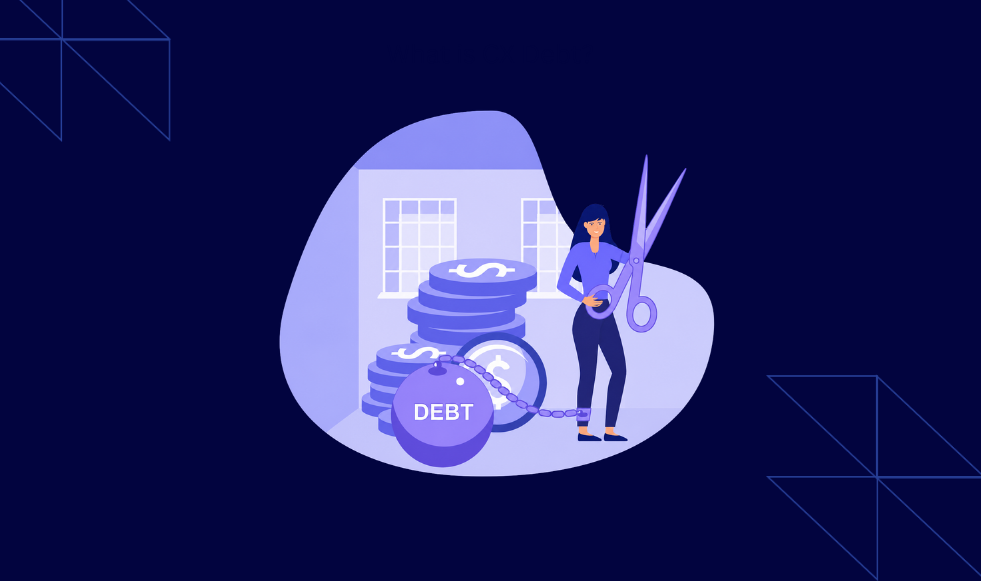
| Quick Definition CX Debt(Customer Experince Debt) is the accumulated hidden costs that a company builds up when it delays investment in customer support. |
Unlike technical debt in software, it doesn’t show up quickly, but is built in the background slowly. According to the latest reports, 81% of the business beloieve that they meet customer expectations, but only 22% of customers say they felt the same way.
Every delayed response, unresolved complaint, or frustrating interaction adds another layer of debt that eventually leads to higher spending on customer retention, reputation management, and customer support.
Some of the common examples of CX debt include:
- Longer customer wait times.
- Reduced support availability.
- Generic, impersonal services.
- Lower first-contact resolution rates.
- Delayed issue escalation.
- Limited self- service resources.
- Inconsistent omnichannel support
It is difficult to measure the CX debt directly like the financial debt. But most of the businesses notice it only when there is a decline in customer satisfaction(CSAT), Net Promoter Score(NPS), repeat purchases, and customer lifetime value.
Why Does CX Debt Matter in 2026?
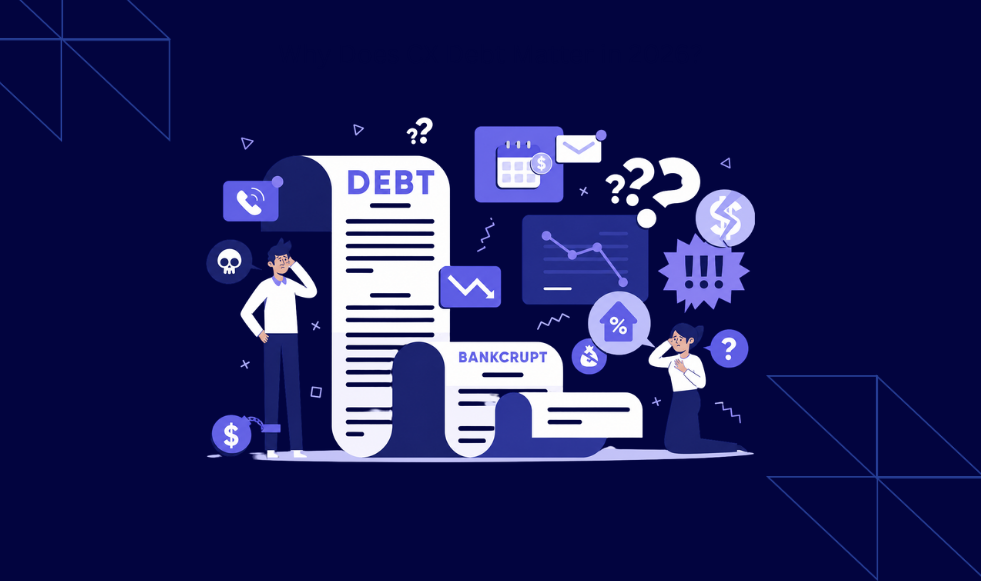
CX debt is important because customer patience is at a record low and switching costs are close to zero.
We’ve seen this so many times working with e-commerce and fintech brands: the companies that cut support first during a downturn are often the same ones scrambling to rebuild trust a year later.
Here is why the timing makes this urgent:
- Expectations Keep Rising: Customers always have high expectations. They always compare your support to the fastest brand they have dealt with. This need not be your direct competitor.
- Silent Churn is Common: Zendesk’s CX trends report for 2026 says that 56% of customers leave the brand rather than complaining.
- The long-term financial cost is significant: According to the Qualtrics XM Institute, globally, organizations could lose nearly $3 trillion in sales by 2026. Consumers will reduce almost $2.1 trillion in spending and will stop spending $865 billion altogether with organizations that provide very poor customer experiences.
- Recovery is expensive: Replacing a lost customer is far more expensive than retaining an existing one.
How Does Customer Experience Technical Debt Build Up?
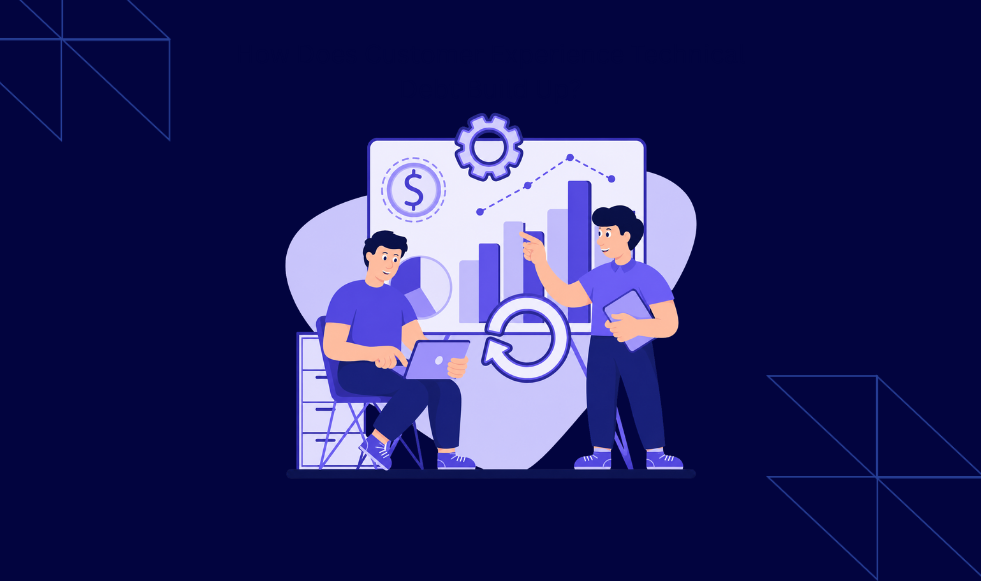
CX debts always build up in layers just like technical debts. Here is how the cycle works.
-
Understaffing during growth
To reduce hiring expenses, businesses put hold of hiring. Reduce training support or limit customer support hours. Ticket volumes rise faster than headcount, so response time slips.
-
Customer Requests Begin to Accumulate
As customer inquiries continue to grow, the support team often struggles to keep pace. Response time increases, backlogs develop, and resolution quality continues to decline.
-
Customer Satisfaction Starts Declining
Longer wait times and inconsistent responses may cause customers to continue to buy, but trust may be reduced. Negative reviews start piling up, making it hard to attract new customers.
-
The Decline in Customer Retention
Dissatisfied customers eventually stop renewing subscriptions, reduce repeat purchases, or have a higher chance of switching to the old competitor. As we have discussed earlier, converting new customers is more expensive than retaining old ones.
-
The Rising Cost of Customer Recovery
Once you witness a significant loss in customer loyalty, it is very hard to rebuild trust again. It requires significant investments.
-
No Feedback Loop
Complaints start piling up. It never reaches the leadership or product teams and remains unnoticed.
In real-world scenarios, we have seen big brands go from their highest CSAT score to a steep downfall just by cutting the customer support headcount during peak sales.
What is the Real Cost of Cutting Support Budget?
One of the biggest mistakes that many businesses make is considering customer support investment as the growth center rather than a growth driver. The real cost of cutting the support budget is not evidently visible in the quarter you are applying. It can gradually show up at a later stage.
| Cost Type | How it Shows Up |
| Lost Revenue | Customers stop buying after a bad experience. |
| Higher CAC | You spend more to replace the churned customers |
| Refund and Chargebacks | Unresolved issues escalate, and disputes erupt |
| Reputation Damage | Negative reviews online can adversely impact the trust of new buyers |
| Lower Repeat Purchase Rate | Faced with one bad experience can affect customer loyalty |
| Increased Employee Turnover | Poor customer experience affects the employees as well, causing higher stress, burnout, and lower morale |
What are the Long-term Consequences of CX Budget Cuts?
CX budget cuts are hurting retention the most, since support is normally the last touchpoint before a customer makes a decision to stay or leave.
Typical outcomes include:
- Longer response times frustrating customers who already expect near-instant answers.
- More repeat contacts for the same issue, a pattern linked to 5x higher churn risk.
- Detractors churn at 6x the rate of promoters, which results in lower NPS scores.
- Less onboarding support, which matters because a large share of SaaS churn happens in the first 90 days.
- Talent strain as overworked agents burn out, higher turnover, and inconsistent quality of service.
From our experience, the drop in retention is not always immediate. It often appears two or three quarters after the budget cut – just when the leadership believes the cut was a clear win.
What is the ROI of Investing in Customer Experience?
Customer experience ROI is a critical metric that measures the financial impact of enhancing customer experience. Investing in customer experience is not just about making customers happy; it is about driving substantial business growth.
Key drivers of growth are
- Customer retention and loyalty
- Revenue growth, cost efficiencies
- Brand differentiation
- Innovation
- Sustainable long-term development
Therefore, ROI is an important customer experience metric for any business that wants to be successful in the long run. In real-world scenarios, businesses that invest consistently in customer experience show growth and are often better positioned because loyal customers continue to purchase even during challenging market conditions.
How Do You Calculate the Customer Experience Investment ROI?
You can calculate the customer experience investment ROI by comparing the cost of the customer support against the retained revenue, reduced churn, and lower acquisition spend it produces.
| ROI= (Financial Benefits- Total CX Investment) _____________________________________ X 100 Total CX Investment |
Here is the simple method you can follow.
- Baseline your churn rate before any CX change. Always.
- Use CSAT, NPS, and resolution time as leading indicators.
- Retained revenue: Revenue from customers who stayed and repurchased after a support interaction.
- Compare with the acquisition cost of replacing an equivalent number of lost customers.
- In efficiencies (e.g., lower cost per ticket through better tools or outsourced scaling).
By way of context, companies that excel at customer experience are reporting 10-15% higher revenue growth than those that don’t. Some AI-supported service models are reporting a $3.50 return on the cost side for every $1 invested.
The formula does both: it justifies investment, and it tells leadership exactly what a cut will cost.
How to Pay Down CX Debt Without Overspending?
You don’t have to cut every round to reduce CX debt. You need capacity that flexes with real demand.
A practical approach is as follows:
- Review existing debt. Check response times, repeat contact rate, and CSAT trend for the last two quarters.
- Find peak-vs-quiet mismatches. Most teams over-invest during the quiet times and then don’t have enough staff for the peaks.
- Increase capacity, not personnel. That way you don’t end up creating the same fixed cost problem you are trying to solve.
- Maintain quality across scaling. Flexible doesn’t have to mean inconsistent — dedicated, trained teams can scale without losing brand voice.
- Track ROI monthly, not annually, so debt doesn’t pile up again unnoticed.
Is Your Business Building CX Debt: 7 Warning Signs to Watch Out For
✔ Customer response times keep increasing
✔ Support tickets continue to pile up
✔ Customer satisfaction scores are declining
✔ Repeat purchases are decreasing
✔ Customer complaints are increasing
✔ Experienced support agents are leaving
✔ Marketing costs are rising just to maintain revenue
Long-term Cost of Poor CX: Common Mistakes Businesses Make
The cost of poor customer experience is not about the loss of sales; it is about the lost customer over time. CX debt rarely occurs due to a single decision; it accumulates over time through a series of small mistakes. These are some of the common mistakes that businesses should avoid.
❌Cutting headcount without cutting volume. Support demands are still the same, but a few agents are available.
❌Reducing investment in employee training. Customer support agents fall behind on product updates and policy changes.
❌Failing to address the customer support channel gaps. Customers often move to the channel that is the fastest.
❌Focusing solely on cost-per-ticket metrics. This overlooks customer satisfaction and repeat support requests.
❌Treating outsourcing as a cost-saving tactic, instead of a scalability strategy.
Final Thoughts
As your business grows, the expectations of the customers keep increasing. Atidiv’s On-demand Customer Support Outsourcing helps fast-growing e-commerce and consumer brands deliver consistent, high- quality customer experience through flexible, scalable support solutions. Whether you need to handle seasonal spikes, improve response time or enhance customer satisfaction, our experienced team integrates seamlessly with your operations to help you reduce the CX debt while optmizing costs.
Discover how ATidiv can turn your customer support experience into a competitive advantage.
Frequently Asked Questions
-
What is CX debt?
The CX debt is the accumulated cost of the unresolved customer expectations, and your support capability, caused by the delayed investment in people, tools or process.
-
Is investing in customer experience worth in 2026?
Absolutely. Investing in customer experience is totally worth in 2026. Companies that invest in CX experience a 10-15% growth in revenue.
-
Is outsourcing customer support the best way to reduce CX debt?
Yes. It is highly effective for scaling business operations, improve response time and maintain service quality without significantly increasing fixed costs.
