


For years, the Philippines has remained one of the most recognized outsourcing destinations for US businesses.
The country built a strong reputation through a combination of lower operational costs, English proficiency, and a mature BPO ecosystem. For finance and bookkeeping functions, especially, the appeal was obvious. Businesses could scale support operations without hiring large in-house teams.
That reputation still exists in 2026, with bookkeepers from the Philippines charging a mere $6 – $14 an hour.
However, the outsourcing landscape has changed significantly over the last few years.
US consumer brands and D2C companies are no longer evaluating outsourcing partners based on cost alone. Leadership teams now care about operational visibility, workflow maturity, automation capability, and long-term scalability.
These are factors that require more than just bookkeeping skill, which the Philippines has aplenty, with the largest per capita CPAs in the world. The concern is not about quality either, as these individuals hold accounting degrees that are on par with US standards.
This is why the conversation around the Philippines bookkeeping outsourcing requires a more substantial understanding.
The question is no longer:
“Is outsourcing cheaper?”
The real question in 2026 is:
“Can outsourced finance operations scale with modern customer experience expectations?”
That is what requires a managed bookkeeping service that can bring consistency to service quality in 2026.
Why D2C Brands Are Re-Evaluating Offshore Finance Operations

As consumer brands grow, operational complexity increases rapidly.
Support tickets increase – This is the intersection between CX and finance that is quite underrated. Data shows that 96% customers turn disloyal with high-effort interactions from their end.
How does this concern finance operations? Most support tickets are finance-related, such as refund requests, and customers do not want their money getting stuck. Now imagine the chaos that would unfold if offshore bookkeepers are slow to reconcile merchant processors (like Stripe or Shopify Payments) with the bank feeds.
Matching support tickets to actual bank transactions becomes a nightmare
Subscription billing becomes harder to manage in case of cancellations/upgradations
Handling returns creates an accounting bottleneck that delays clean book closures.
At the same time, leadership teams still expect accurate reporting and real-time visibility into performance.
This creates pressure on internal finance teams.
For many D2C companies generating $5M+ in annual revenue, bookkeeping is no longer a simple back-office function.
It directly impacts:
- customer retention
- operational planning
- inventory forecasting
- profitability visibility
- marketing allocation decisions
As a result, many brands turn toward offshore bookkeeping services to reduce operational strain while maintaining reporting consistency.
The goal is no longer just delegation. It is scalability across departments that drives all-around growth for the company. In 2026, you do not hope for success – you design it.
Why the Philippines Became a Global Outsourcing Leader

The Philippines became dominant in outsourcing through several structural advantages.
Strong English Communication
Communication quality remains one of the country’s biggest strengths.
For US, UK, and Australian businesses, this reduces operational friction significantly. And with 47% adults in the population fluent in English, the Philippines becomes one of the best choices.
Finance workflows often require coordination between:
- customer experience teams
- finance managers
- operations leaders
- external vendors
Clear communication matters at every stage.
Mature BPO Infrastructure
The country invested heavily in outsourcing infrastructure over the last two decades.
This led to:
- structured operational systems
- standardized workforce training
- mature remote collaboration environments
- scalable delivery models
Many bookkeeping outsourcing companies in the Philippines now operate with highly process-oriented systems.
Competitive Labor Costs
Cost savings remain important.
Building internal finance teams in the US is expensive.
For growing D2C brands, balancing customer acquisition costs and operational expansion, outsourcing still provides financial flexibility.
This continues to support demand for offshore bookkeeping in 2026.
Familiarity With Western Business Processes
Philippine outsourcing firms have years of experience supporting US businesses.
This creates familiarity with:
- ecommerce accounting workflows
- US reporting expectations
- cloud accounting systems
- subscription business models
- customer-facing operational environments
This shortens onboarding timelines.
What Offshore Bookkeeping Actually Looks Like in 2026
Modern offshore accounting is far more advanced than traditional transaction entry.
Today’s finance outsourcing relationships often include:
- bank reconciliations
- accounts payable and receivable
- invoice processing
- ecommerce reconciliation
- payroll support
- reporting assistance
- cloud accounting platform management
Many outsourcing teams also support operational finance workflows tied directly to customer experience.
For example:
- refund reconciliation
- payment dispute tracking
- return-related reporting
- subscription billing support
This overlap between finance operations and customer experience is becoming increasingly important for D2C brands.
How Outsourcing Decisions Have Changed in 2026
A major shift has happened over the last few years.
Businesses are no longer outsourcing purely for labor arbitrage.
Leadership teams now evaluate providers based on:
- process maturity
- reporting visibility
- workflow integration
- scalability
- automation capability
- operational consistency
This is especially true for CX-focused brands.
When financial reporting becomes inconsistent, leadership loses visibility into performance.
That affects:
- inventory planning
- retention forecasting
- support operations
- revenue analysis
- customer lifecycle management
As a result, modern offshore accounting plays a much larger operational role.
The Continued Strength of the Philippines Bookkeeping Outsourcing
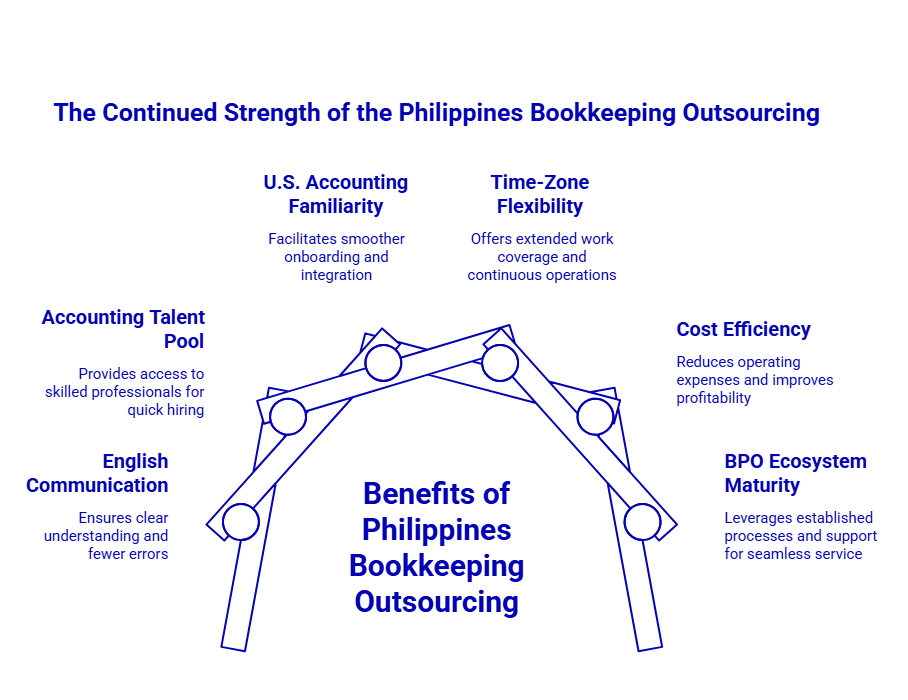
Despite increased global competition, the Philippines remains highly competitive.
Large Workforce Availability
The country continues to produce finance and accounting graduates at scale.
This supports workforce expansion.
Many US consumer brands prefer this because finance operations can scale without rebuilding internal teams repeatedly.
Experience With US Clients
Many Philippine providers already understand US workflows.
Teams are familiar with:
- QuickBooks
- Xero
- NetSuite
- ecommerce accounting systems
- US payroll environments
This reduces operational friction.
For D2C brands handling high transaction volume, familiarity with ecommerce accounting workflows matters significantly.
Established Remote Infrastructure
Remote work accelerated outsourcing maturity significantly.
Many providers now operate with stable, distributed delivery systems.
This improves continuity and scalability.
For growing brands, operational continuity matters just as much as cost efficiency.
Strong Operational Flexibility
Consumer brands often experience seasonal transaction spikes.
Holiday sales periods, promotional campaigns, and marketplace expansion can increase bookkeeping complexity quickly.
Outsourcing allows businesses to scale operational finance support without continuously expanding internal teams.
This flexibility remains one of the strongest reasons companies still consider Philippines bookkeeping outsourcing in 2026.
Where Businesses Are Starting to See Limitations
The market remains strong, but expectations have evolved.
Rising Labor Costs
Global outsourcing demand increased salary expectations across the industry. To provide some context, the Philippines has seen a recent hike in minimum wages, which could impact salaries.
Thus, the idea that the pricing gap between offshore destinations provides cost incentives to businesses could be slowly losing its firm grip on reality.
Although the Philippines still remains cost-effective, businesses are now evaluating value beyond hourly rates.
Talent Competition
Experienced finance professionals are heavily recruited across industries.
Retention challenges can affect continuity for some providers.
This becomes important when brands rely on long-term operational familiarity.
Scalability Differences Between Providers
Not all outsourcing firms scale effectively.
Some smaller providers struggle to maintain consistency as client volume increases.
This creates reporting variability and workflow instability.
For D2C brands managing customer experience operations across channels, inconsistent finance reporting creates downstream operational problems.
Real-Time Collaboration Challenges
Some US businesses now expect stronger timezone overlap.
This becomes important when finance workflows intersect directly with:
- refund approvals
- customer escalations
- subscription billing issues
- operational reporting requests
As customer experience operations become more integrated with finance workflows, real-time coordination matters more than it did previously.
This is why evaluating what services are offered matters more than you think in 2026 – it is not a scrutiny that you need but a deliberate process of vetting quality.
How to Evaluate Offshore Bookkeeping Providers in 2026
The evaluation process should focus on operational maturity rather than pricing alone.
Review Workflow Structure
Assess:
- reporting systems
- QA workflows
- escalation paths
- documentation standards
Structured systems improve consistency over time.
Evaluate Technology Capability
Modern providers should support:
- cloud accounting systems
- automation workflows
- integrated reporting environments
Businesses increasingly expect real-time visibility into finance operations.
Review Security Standards
Financial data security matters significantly.
Businesses should assess:
- access controls
- compliance procedures
- data handling policies
Operational trust becomes critical once offshore teams integrate deeply into workflows.
Evaluate Communication Systems
Communication quality affects operational clarity.
Structured reporting systems reduce confusion and improve accountability.
Test Scalability
The right provider should support long-term growth.
Scalability matters more than short-term savings.
This becomes increasingly important for fast-growing consumer brands.
Philippines vs Internal Finance Hiring: A Practical Comparison
Let us now take a look at the practical advantages of outsourcing your bookkeeping functions so that you have a mental checklist to refer to.
| Factor | In-House Team | Philippines Outsourcing |
| Hiring Cost | High | Lower operational cost |
| Scaling Speed | Slower | Faster team expansion |
| Access to Talent | Limited by geography | Large offshore talent pool |
| Ecommerce Workflow Familiarity | Depends on hiring | Common among providers |
| Operational Flexibility | Moderate | High |
| Reporting Support | Internal bandwidth dependent | Dedicated operational support |
| Infrastructure Cost | Higher | Lower |
| Long-Term Scalability | Expensive to expand | Easier to scale gradually |
For growing D2C brands, the decision is often less about replacing internal finance leadership and more about building operational support layers that scale efficiently.
For this reason, there is a need to opt for managed bookkeeping services so that oversight does not become a day-to-day problem.
How Atidiv Helps Consumer Brands Build Scalable Finance Operations
Modern finance operations require more than transactional bookkeeping.
Atidiv helps consumer brands and D2C companies build scalable finance support systems aligned with operational growth and customer experience expectations. We have been consistently delivering these services for over 16 years in the industry:
- Structured workflows improve reporting consistency
- Dedicated support teams reduce operational bottlenecks
- Cloud-based finance systems maintain visibility across workflows
- Scalable delivery models support high-transaction environments
- Process-driven operations improve long-term reliability
For businesses evaluating Philippines bookkeeping outsourcing, the focus should not simply be on location or hourly cost.
The more important question is whether the operational model supports scalability, reporting visibility, and customer experience consistency as the business grows.
Contact us today for a quote, with hourly rates starting at just $15!
Philippines Bookkeeping Outsourcing FAQs
1. Is the Philippines still a strong outsourcing destination for bookkeeping in 2026?
Yes. The Philippines remains highly competitive because of its mature BPO ecosystem, strong English communication, and extensive experience supporting US businesses.
2. What services are typically included in offshore bookkeeping?
Modern offshore bookkeeping services often include reconciliations, invoice processing, accounts payable and receivable, payroll support, ecommerce reconciliation, and reporting assistance.
3. Why are D2C brands increasingly outsourcing bookkeeping operations?
Growing D2C brands often experience increasing transaction complexity across ecommerce channels. Outsourcing helps improve reporting consistency and operational scalability without continuously expanding internal finance teams.

Maximilian Straub is the Chief Operating Officer for Guild Capital and oversees all areas of the company's strategic operations and portfolio performance across the world. He is also a board member for Atidiv, supporting its growth initiatives. He served as the Chief Operating Officer and Chief Financial Officer for Spring Place and had previously spent 7 years advising clients in strategy, operational execution and organizational transformation while at McKinsey & Company.