


WhatsApp business customer support has moved well beyond simple message handling. For many brands, it now sits close to conversion, retention, and day-to-day service quality. The companies scaling it well usually do a few things early: they build clear queue ownership, move off informal inbox handling, use automation selectively, and connect WhatsApp to their wider support workflow. Once volume rises, WhatsApp support outsourcing often becomes the clearest way to maintain speed without letting quality slip.
Why WhatsApp Has Become A Serious Support Channel?
There is a reason more support leaders are taking WhatsApp seriously now than they did a few years ago.
First, the audience is simply too large to ignore. More than 3 billion people in over 180 countries use the app. That alone changes the conversation. A channel with that kind of reach stops being a “nice to have” and starts becoming infrastructure for customer contact.
Second, the business tooling has matured. WhatsApp itself now positions the platform as a way to drive marketing, sales, and support outcomes, not just one-to-one customer messaging. WhatsApp Business Platform specifically supports automation, customer service engagement, interactive features, and integration paths that are clearly meant for scaled operations rather than one person replying from a phone.
That is why WhatsApp business customer support has become a much more practical topic in 2026. Brands are no longer asking whether customers will use it. The real question is whether the company can run the channel properly once customers do.
What WhatsApp Business Customer Support Actually Means At Scale?
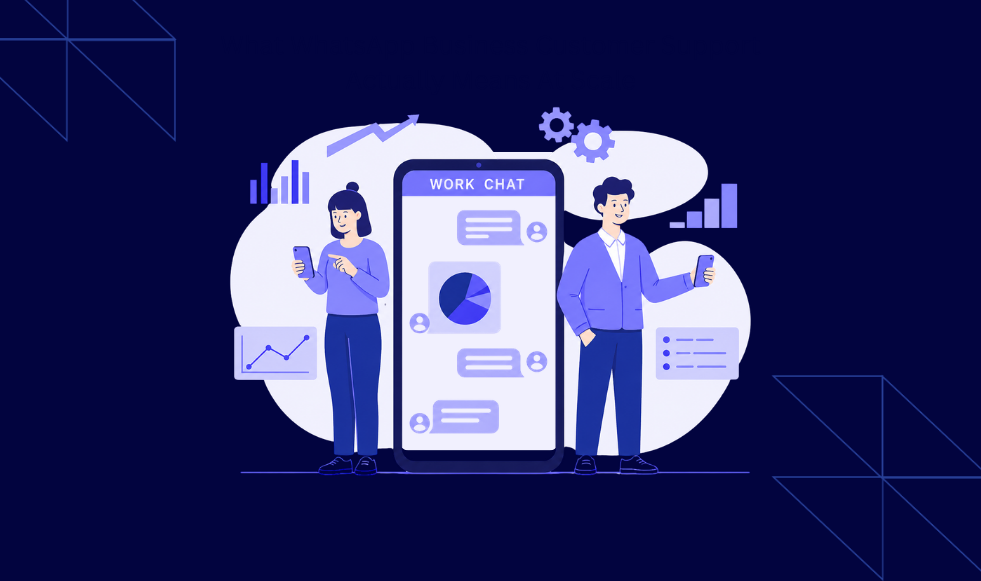
A lot of teams still picture WhatsApp business customer support as a basic chat function: a customer messages the business, someone replies, issue solved.
That works for very small volumes. It does not hold once support demand starts to stack up across order updates, product questions, billing follow-up, service recovery, and post-purchase guidance.
At scale, WhatsApp business customer support usually includes a few moving parts:
| Functional Area | What It Usually Covers |
| Frontline Messaging | Product questions, order issues, and account help |
| Routing And Triage | Directing chats to the right queue or team |
| Automation | Greeting, intent capture, FAQ handling, workflow triggers |
| Escalation | Moving sensitive or complex cases to specialists |
| Reporting | Response times, resolution health, backlog, and handoff quality |
This is also where WhatsApp support outsourcing starts showing up in real conversations. Once the channel becomes a live service queue rather than a side inbox, someone has to own staffing, routing, QA, reporting, and escalation discipline. Many internal teams are not structured for that.
For a consumer brand with 3+ employees, WhatsApp business customer support usually stops feeling “manageable” the moment the same person is expected to handle marketing posts, support questions, and escalation follow-ups inside one channel.
That is not a technology problem. It is an operating model problem.
Best Practice #1: Treat WhatsApp Like A Queue, Not A Side Inbox
The first mistake teams make with WhatsApp business customer support is treating it like a casual messaging stream.
It is not.
Once customer volume is steady, WhatsApp needs queue ownership the same way email, chat, or voice support does. That means:
- Named coverage windows
- Response expectations
- Escalation rules
- Closure logic
- Accountability for unresolved threads
Sprout Social’s 2023 customer care data is a useful backdrop here. It found that managing high request volume is the top challenge for customer care professionals, and it also found that nearly 75% of customers want brands to respond within 24 hours or less. Those are not WhatsApp-only findings, but they matter because messaging channels train customers to expect fast, direct replies.
If WhatsApp business customer support is still being monitored informally, that expectation gap becomes obvious fast.
A cleaner way to manage the channel is to define it like a support queue:
| Queue Rule | Why It Matters |
| First response SLA | Prevents invisible backlog |
| Ownership by shift or team | Stops messages from sitting unclaimed |
| Escalation thresholds | Prevents frontline confusion |
| Close criteria | Avoids “open forever” conversations |
This is one reason WhatsApp support outsourcing often becomes attractive. External teams are usually more comfortable treating messaging as a governed service channel from day one.
Best Practice #2: Move To The Right WhatsApp Stack Before Volume Forces You To
The second mistake is waiting too long to move from a basic setup to one built for scale.
WhatsApp itself distinguishes between its broader business solutions and the Business Platform built for larger-scale messaging use cases. The Business Platform supports automated messages, chatbots, interactive CTAs, dynamic product lists, and more. It is designed for integration and volume, not just ad hoc business chatting.
This matters because WhatsApp business customer support breaks down quickly when the stack cannot support:
- Multiple agents
- Routing logic
- System integrations
- Conversation visibility
- Structured message handling
If a team is still relying on a single-device or loosely shared model, the support experience becomes fragile. Handoffs get missed. Reporting is partial. Managers cannot see the workload clearly.
So when you think about WhatsApp business customer support, do not ask only, “Can we answer messages?” Ask, “Can we operate the channel when volume doubles?”
For a D2C company earning $5M+ revenue, the stack decision in WhatsApp business customer support usually matters more once pre-purchase questions, order tracking, and post-purchase support all start arriving in the same stream.
That is usually the moment when WhatsApp support outsourcing enters the discussion, because the software and the staffing model often need to evolve together.
Best Practice #3: Use Automation For Routing, Not For Everything
Automation belongs in WhatsApp business customer support, but not in the way some teams first imagine.
The trap is obvious: over-automate, frustrate customers, then blame the channel.
Used well, automation should remove repetitive handling and speed up the path to the right answer. Used badly, it creates dead ends.
The platform explicitly supports automation, customer service engagement, and interactive experiences. WhatsApp Flows, for example, were introduced to let businesses create structured experiences directly in chat without sending the customer to another app or site. That can be useful for appointments, guided forms, or structured support requests.
A sensible automation split usually looks like this:
| Use Automation For | Keep Human |
| Greeting and acknowledgment | Sensitive complaints |
| Intent capture | High-value purchase guidance |
| FAQ routing | Exceptions and edge cases |
| Status requests | Negotiation, retention, or recovery cases |
| Structured form collection | Any conversation where empathy matters more than speed |
That is one of the more practical rules in WhatsApp business customer support: automate entry and routing, not the whole relationship.
This is also why WhatsApp support outsourcing often works better than a purely tool-led approach. A strong outsourced team can use automation to shorten the path, then step in before the experience starts feeling mechanical.
Atidiv helps brands structure WhatsApp business customer support so automation handles triage, FAQs, and workflow triggers while human agents stay focused on the conversations that affect trust, conversion, or customer recovery.
Best Practice #4: Connect WhatsApp To The Rest Of Your Support Operation
A lot of channel-specific support strategies fail because they stay trapped inside the channel.
The customer does not think that way. They may start on WhatsApp, follow up by email, then return with another question after a missed shipment. If those interactions live on separate islands, the experience feels disjointed.
That is where multichannel customer support logic matters, even if we currently focus on WhatsApp.
HubSpot’s 2024 State of Service report notes that omnichannel support helps unify the service experience. That may sound obvious, but it matters in practice because disconnected channels create repeated explanations, duplicate handling, and frustration for both customers and agents.
For WhatsApp business customer support, that means the channel should connect to:
- CRM or customer records
- Order and delivery context
- Ticketing or escalation systems
- Prior support history
If the WhatsApp team has no context, response speed alone will not save the experience.
This is also where WhatsApp support outsourcing deserves a more practical evaluation. The best partner is not just fast in-channel. They can operate WhatsApp as part of a broader service system.
For a VP, Director, or senior manager of a growing D2C company, WhatsApp business customer support becomes much easier to scale once it is tied into order context and the wider service workflow rather than handled as a stand-alone messaging stream.
Best Practice #5: Write For Speed Without Sounding Robotic
Messaging channels expose bad writing quickly.
If a brand sounds stiff, evasive, or obviously templated in email, customers may tolerate it. On WhatsApp, it stands out immediately because the channel itself feels more personal.
That is one reason WhatsApp business customer support can improve customer experience when done well and damage it when done lazily. The format is intimate enough that poor writing reads as indifference.
A useful messaging standard usually balances four things:
- Short enough to be readable on mobile
- Clear enough to avoid repeated questions
- Warm enough to feel human
- Specific enough to move the issue forward
This is also where WhatsApp support outsourcing can help or hurt, depending on training quality. An outsourced team with no tone guidance will default to generic service language. A well-trained team will sound direct, calm, and brand-consistent.
Here is a simple comparison:
| Weak Reply | Strong Reply |
| “We are sorry for the inconvenience. Kindly wait.” | “I checked the order, and it’s delayed in transit. I’ve flagged it with the courier, and I’ll update you here by 3 PM.” |
| “Please refer to our policy.” | “You can return this within 14 days. If you want, I can also send the return steps here so you don’t have to look them up.” |
That difference is not cosmetic. It changes whether the customer feels helped.
For a D2C brand operating in multiple regions like the US, UK, and Australia, tone consistency in WhatsApp business customer support becomes more important as support coverage expands across shifts, teams, and time zones.
Best Practice #6: Measure The Channel Like It Matters
The last best practice is simple, but it is where many teams still underperform: measure WhatsApp separately and seriously.
If WhatsApp business customer support is treated as a side channel in reporting, it usually becomes a side channel operationally, too.
Useful metrics include:
- First response time
- Resolution rate
- Backlog volume
- Escalation rate
- CSAT or sentiment indicators
- Repeat contact rate
- Pre-sales conversion assistance where relevant
You do not need a huge dashboard. You need enough visibility to answer whether the channel is healthy.
Sprout’s research that nearly 75% of consumers want brands to respond within 24 hours or less is a useful reminder here. Response speed still matters, but speed alone is not enough. The interaction also has to feel personal and complete.
This is one of the clearest cases for WhatsApp support outsourcing, too. If the partner cannot show queue health, response quality, escalation patterns, and trend data, then scale will feel messy even if the raw answer volume is high.
Atidiv supports WhatsApp business customer support with reporting that shows not only speed, but also resolution quality, escalation behavior, and channel-specific friction points – so teams know whether the operation is actually scaling well. Book a free call to learn how we can help you!

When WhatsApp Support Outsourcing Starts Making Sense
The question is rarely “Should we outsource WhatsApp?” in the abstract.
The better question is: When does internal handling stop being efficient enough?
Typical signals include:
- Inconsistent response times
- Messages waiting overnight or across weekends
- No clear owner for escalations
- Support volume spilling into marketing or sales work
- Repeated customer frustration caused by slow follow-up
That is when WhatsApp support outsourcing starts to make sense – not because outsourcing is automatically better, but because the existing support model is no longer holding up.
The strongest use cases tend to be:
- E-commerce brands with high order status and product question volume
- Service businesses handling appointment or status updates
- Growth-stage teams that need broader coverage without a full in-house support buildout
A lot of teams assume they should keep WhatsApp internal until they are “big enough.” In reality, WhatsApp support outsourcing is often most useful in the awkward middle – when the channel is too busy to handle casually, but the company does not want to build another internal team from scratch.
What To Look For In A WhatsApp Support Outsourcing Partner
If a company is considering WhatsApp support outsourcing, the evaluation should be more operational than cosmetic.
The right partner should be able to explain:
- How staffing coverage works
- How automation and human handoff are designed
- How tone and templates are governed
- How order context or CRM data is accessed
- How escalation paths are documented
- What reporting comes with the service
That last point matters a lot.
A weak partner talks mostly about response volume. A strong one talks about queue logic, quality control, and how WhatsApp business customer support fits into the wider customer journey.
Conclusion
WhatsApp business customer support works best when companies stop treating it like a lightweight add-on. It sits too close to purchase questions, service recovery, and real-time customer trust for that.
The brands scaling well are doing a few things early: they give the channel clear ownership, move onto the right business stack before volume breaks the workflow, automate the repetitive parts without over-automating the relationship, connect WhatsApp to the wider support system, train for natural writing, and measure the channel with real discipline.
That is why WhatsApp support outsourcing is becoming more common. It gives businesses a way to keep pace without forcing every support challenge back onto internal teams.
How Atidiv Improves WhatsApp Customer Support At Scale In 2026
Atidiv helps brands treat WhatsApp business customer support as a real operating channel rather than an improvised message stream.
That usually includes:
- Queue design and ownership rules
- Frontline support staffing
- Selective automation and routing logic
- Escalation paths
- Reporting on speed, quality, and resolution health
- Integration thinking across broader service workflows
For teams considering WhatsApp support outsourcing, the biggest gain is often not lower cost first. It is operational stability. The channel becomes easier to run, easier to monitor, and easier to improve.
Talk to us to build a WhatsApp support model that handles volume cleanly, protects customer experience, and scales without creating channel chaos.
FAQs On WhatsApp Business Customer Support
1. What is WhatsApp business customer support?
It is the use of WhatsApp as an active customer service channel for questions, updates, problem resolution, and post-purchase communication. At scale, WhatsApp business customer support usually involves structured routing, multiple agents, automation, and integration with other systems.
2. Why are more companies considering WhatsApp support outsourcing now?
Because the channel is now large enough and active enough to matter operationally. WhatsApp says it has more than 3 billion users, and many customers already expect fast messaging-based help. That makes WhatsApp support outsourcing a practical option once internal teams start struggling with coverage or consistency.
3. What are the biggest mistakes in WhatsApp business customer support?
The usual ones are treating the channel like an informal inbox, over-automating early interactions, and failing to connect WhatsApp to the wider support workflow. Those mistakes create speed without clarity.
4. Does WhatsApp support outsourcing mean losing quality control?
Not if the model is set up well. In many cases, WhatsApp support outsourcing improves consistency because queue ownership, reporting, and QA become more formal than they were internally.
5. When should a brand move from a basic setup to a more scalable WhatsApp model?
Usually, when support volume increases, multiple agents need access, or the channel starts affecting conversion and retention. At that point, WhatsApp business customer support needs better tooling, clearer ownership, and more structured operations than a lightweight setup can provide.

Maximilian Straub is the Chief Operating Officer for Guild Capital and oversees all areas of the company's strategic operations and portfolio performance across the world. He is also a board member for Atidiv, supporting its growth initiatives. He served as the Chief Operating Officer and Chief Financial Officer for Spring Place and had previously spent 7 years advising clients in strategy, operational execution and organizational transformation while at McKinsey & Company.