


To augment live contact agents is to give the people answering your chats, calls and emails AI that works beside them during the conversation: it finds the answer, drafts the reply, summarizes the history and flags an upset customer, while the agent decides what to say and do. The customer still talks to a person. The person just stops searching, retyping and guessing. This is augmented service, and it is the practical middle ground between an all-human team and a bot that answers everything.
For CX leaders at consumer brands in the US, UK and Australia, it is usually the fastest way to cut handle time without making customers fight a chatbot to reach someone. We run this model every day in our AI-powered support teams, and this guide covers what it is, the tools that do it today, how to roll it out and how to tell whether it is working.
Key takeaways
- An augmented agent is a human agent with AI support built into the workspace, so answers, context and drafts appear during the live contact rather than after it.
- Augmenting agents and automating contacts are different decisions. Automation removes a contact; augmentation makes the contacts people handle faster and more accurate.
- Every major help desk now ships an agent assistant, so most teams can start with a setting and a pilot, not a new platform.
- Start small, on the two or three contact types that cost the most time, and measure before and after.

What Is an Augmented Agent for Customer Service?
An augmented customer service agent is a human agent aided by smart technology such as AI, machine learning and automation. It is part of a larger approach called augmented customer service, where automation and people work together rather than compete. In practice it looks like this:
- Instead of digging through help pages, the agent sees the right article or answer as soon as the ticket opens.
- When a ticket arrives, routing sends it to the agent with the right skills and language.
- During a live chat, the system suggests a reply the agent can edit and send, so they move quicker.
- AI reads the customer’s tone and flags frustration, so the agent can slow down and take extra care.
- When the contact ends, the summary and tags are written for the agent to check rather than type.
The result is service that is faster, more personal and easier to scale, without losing the empathy and judgment only a person brings.
Augment or automate: two different decisions
The two words get used as if they meant the same thing. They do not.
| Automate the contact | Augment the agent | |
|---|---|---|
| Who the customer talks to | A bot or AI agent | A person, with AI helping |
| Best for | Simple, repeatable requests: order status, password resets, store hours | Refunds, complaints, damaged orders, billing, anything with judgment or emotion |
| What it saves | The whole contact | Minutes inside each contact |
| Main risk | Customers trapped in a loop | Agents trusting a wrong suggestion |
| How you measure it | Containment and deflection | Handle time, first-contact resolution, CSAT |
Most teams need both. The mistake is using automation for contacts that need a person. In a 2023 Gartner survey of 5,728 customers, the top worry about AI in customer service was that it would make it harder to reach a person. Augmenting live contact agents answers that concern directly, because the person stays in the conversation.

Why Agent Augmentation Changes the Work
Agents juggle several conversations, search help docs, try not to sound scripted and work out complex issues on the fly. Augmented service takes the searching and retyping off their plate. Here is what changes:
- Faster responses. With answers suggested, related articles surfaced and customer details filled in, agents get to the point sooner. Fewer pauses mean shorter conversations and fewer customers giving up.
- Higher accuracy. People make mistakes when they are swamped. An assistant that pulls from the knowledge base, past tickets and the order record gives the agent the current policy, not the one they remember. That means fewer follow-ups and fewer reopened tickets.
- Happier agents. When the repetitive work shrinks, agents spend more of the shift on conversations that need them. That tends to help with burnout and turnover, which are expensive in any support team.
- More personal service. The assistant brings up past purchases, the last contact and the customer’s tone, so the agent can respond to this customer rather than to a ticket. Salesforce’s State of the Connected Customer research found that 73% of customers expect better personalization as technology advances.
- Consistent quality. A new hire and your best agent see the same suggested answer and the same policy. Quality depends less on who happened to pick up.
What AI does before, during and after a live contact
It helps to map augmentation onto the life of one contact. The human agent augmentation blueprint Twilio publishes follows the same shape: context before the agent joins, assistance while they work, and wrap-up once the conversation ends.
| Stage | What the AI does | What the agent still owns |
|---|---|---|
| Before | Classifies the contact by topic, language and sentiment; routes it; shows order and contact history | Reading the context and deciding the approach |
| During | Suggests replies and next steps; finds articles and similar solved tickets; adjusts tone; translates | Judgment, empathy, exceptions and anything involving money or policy |
| After | Summarizes the conversation, suggests tags and disposition, drafts follow-ups | Checking the summary and closing the loop |
The “after” stage is often the quickest win: a summary the agent only has to check is easy to trust and easy to measure.

How to Implement Augmented Agent for Customer Service
You do not need to overhaul your support systems overnight to implement augmented customer service. Gradual adoption, focused on tools, training and measurable wins, works best.
1. Start with the right tools
You cannot have augmented agents without the technology behind them. The good news in 2026 is that the main help desks now build agent assistants in, usually as an add-on, so the first step is often switching features on in the platform you already use.
| Platform | Agent assistant | What it does for the agent |
|---|---|---|
| Zendesk | Agent copilot, part of the Copilot add-on | Auto assist suggestions and approved actions, suggested first replies and macros, writing and tone help, ticket summaries, similar tickets, and intelligent triage for intent, sentiment and language |
| Intercom | Copilot, in the Inbox | Answers agent questions from past conversations, help center and internal articles, macros and synced content, and suggests next steps. Fin is Intercom’s separate, customer-facing AI agent |
| Freshdesk | Freddy AI Copilot | Suggests replies, summarizes and translates conversations inside the agent workspace |
| Salesforce | Agentforce for Service | Service Replies from your knowledge base, AI-generated conversation summaries, and a Service Rep Assistant that guides reps through a case |
Whichever you use, check three things before you roll it out: which content the assistant is allowed to read, whether agents can see the source behind each suggestion, and whether you can turn features on for one team first.
2. Train agents to use AI as a teammate
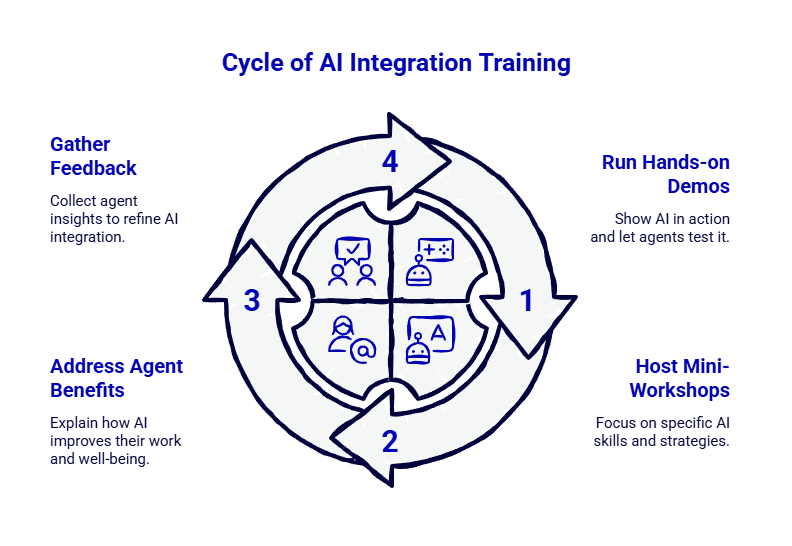
Augmentation only works if your team sees AI as a partner rather than a threat. Training is what makes that happen:
- Run hands-on demos. Show how the assistant helps during a live chat or ticket. Let agents try it on real, closed tickets and see the time it saves.
- Teach when to override. The most useful skill is knowing when a suggestion is wrong. Walk through examples of confident but incorrect answers.
- Answer “what is in it for me?” Less retyping, fewer repeat questions and less wrap-up at the end of a shift.
- Build feedback into the process. Give agents a quick way to mark a suggestion as wrong or outdated, and show them what changed because they did.
3. Focus on use cases first
Do not try to solve everything at once. Look for where agents get stuck, what slows responses and where errors creep in. Common starting points:
- Slow email replies. Use AI to draft replies or fill in order details so agents do not start from scratch.
- Overloaded live chat. Let a bot handle simple FAQs, then hand complex cases to a person with the context attached.
- Hard-to-find information. Give agents an assistant that searches help docs, past tickets and the knowledge base as they type.
- Messy tagging. Let AI suggest tags from past patterns, and have agents confirm them.
Pick two or three. Proving value on a narrow set is what earns support for the next phase.
4. Monitor and optimize
Treat augmentation as a live part of your operation, not a one-time install:
- Watch how agents use suggestions. Are they sending them as-is, editing them or ignoring them? Heavy editing points to a knowledge base problem.
- Ask your agents regularly. Do not wait until something breaks.
- Track performance in your platform’s analytics: resolution time, deflection, suggestion acceptance and CSAT.
- Refine from the data. If the same answer is rewritten every day, fix the article it comes from.

How to Measure the Impact of Agent Augmentation
Take a baseline for four to six weeks before rollout, then compare the pilot team with a team that is not using the assistant yet. These are the numbers that tell you whether it is working:
| Metric | What it tells you | What good looks like |
|---|---|---|
| First response time (FRT) | Whether suggested first replies and routing get agents moving sooner | Falls in the pilot group without a drop in quality scores |
| Average handle time (AHT) | Whether agents solve contacts faster with answers surfaced for them | Falls, especially on the contact types you targeted |
| First-contact resolution (FCR) | Whether better answers stop the customer coming back | Rises, with fewer reopened tickets |
| CSAT | Whether customers notice the difference | Holds or rises; a fall means speed is costing accuracy |
| Suggestion acceptance rate | Whether agents trust the assistant | Steady; very high can mean agents are not reading, very low means the content is weak |
| Bot-to-human handoff | Whether context travels with the customer | Customers rarely repeat themselves after a handoff |
| QA scores | Whether answers stay accurate and on-brand | Holds or rises on the reviewed sample |
Our guide to essential call center metrics covers how to calculate each one.

Common Pitfalls to Avoid with Agent Augmentation
- Over-automation. If AI does everything, you lose the human touch customers are asking for. Use AI to support agents. The bot answers FAQs, routes and suggests; the person steps in when the conversation matters.
- Ignoring agent feedback. Agents spot a wrong suggestion long before management does. Make it easy for them to say so, and act on it.
- Skipping training. An assistant switched on without training gets ignored or trusted blindly. Treat it like product training.
- A stale knowledge base. The assistant is only as good as what it reads. If policies change and the articles do not, it will suggest the old answer with confidence.
- One-size-fits-all replies. A canned reply with no context feels robotic. Tune the tone settings and make agents edit before they send.
- No clear line on data. Decide what customer data the assistant can read and where it is processed before rollout, especially for payment or health details.
When outsourcing augmented support makes sense
Building augmented service in-house means choosing tools, cleaning up the knowledge base, training agents and running QA on AI-assisted replies. Outsourcing makes sense when:
- Volume swings with launches, promotions or holidays, and you need trained agents who already work this way.
- You want 24/7 or multi-time-zone coverage without building night shifts.
- Your team does not have time to own the knowledge base and QA the assistant depends on.
- You want to automate repeat questions but keep a person on everything that affects a refund, a complaint or a customer’s trust.
Keep policy decisions, refund exceptions and your brand voice guide in-house. Hand over the daily running.

The Future of Support Is Human + AI
Customer service will always need people for empathy and judgment. Pair them with AI that finds the answer and writes the notes, and you get faster replies and less burnout without losing the personal touch.
At Atidiv, we help CX leaders at consumer brands build support teams where AI handles the repetitive work and trained agents handle the conversations that matter. Our customer experience teams in India and the Philippines work inside your tools, across chat, email, voice and social.
- 30 to 80% of repeat queries automated, with QA guardrails
- 98% average QA score and a 4.8 average CSAT
- 200,000+ customer experiences delivered
- Around 60% less than an in-house team
- SOC 1, GDPR, CCPA and ISO compliance
See how it works on our AI customer support outsourcing page, or contact us to talk it through.
Frequently asked questions
What does it mean to augment live contact agents?
It means adding AI to the workspace of the agents handling live chats, calls and emails, so they get context before the contact, suggestions during it and a written summary after it. An augmented agent is a human support representative assisted by AI features such as suggested replies, knowledge surfacing, conversation summaries and ticket routing. The AI handles searching, drafting and note-taking, while the person handles judgment and empathy, and the customer still deals with a person. This is also called augmented customer service.
How does agent augmentation improve support quality?
It removes repetitive work, gives every agent the same current answer, speeds up responses and brings customer context to the screen, which leads to fewer errors and fewer repeat contacts.
What tools support agent augmentation?
Zendesk agent copilot, Intercom Copilot, Freshdesk Freddy AI Copilot and Salesforce Agentforce for Service all include agent assistance features such as suggested replies, summaries and knowledge search. Most are sold as add-ons to the help desk you already use.
Is AI replacing human agents in customer service?
Not for contacts that matter. AI can fully handle simple, repeatable requests, but customers still want a person for complex, emotional or high-stakes issues. Augmentation keeps that person and makes them faster.

Kushal is Atidiv's Head of Growth, responsible for driving business growth through a data-driven growth strategy and collaboration across functions. He has scaled digital products, created sales engines, improved user journeys, and enhanced funnel performance. He is recognized for his ability to "think big" when tackling difficult issues and producing measurable success in a fast-paced environment.