


Table Of Contents
- Why Separate Call Queues Create Waste
- What a Blended Model Includes
- How Blended Routing Works
- Where Inbound and Outbound Work Fit Together
- Operational Benefits
- Staffing and Training
- Technology and Compliance
- Implementation and Measurement
- How Atidiv Can Help With Inbound Demands And Outbound Commitments In 2026
- Blended Call Center Outsourcing FAQs
A blended call center brings inbound support and outbound outreach into one operating model. As demand changes, trained agents can move between customer calls, callbacks, retention outreach, surveys, and sales activity. The model can improve coverage and use available capacity more effectively, provided routing, training, compliance, and performance measures are designed with care.
Why Separate Call Queues Create Waste

Inbound and outbound teams are often built as separate departments. One group waits for customers to call, while the other works through campaigns, callbacks, or lead lists. The structure is easy to understand, but it can leave one team overloaded while the other has spare capacity.
Inbound demand changes by hour, season, and event. A product launch may create a sudden wave of delivery questions. A quiet afternoon may leave trained agents waiting. Many outbound tasks, including surveys, renewals, and follow-ups, can be paused when inbound demand rises and resumed when queues settle.
Blended call center outsourcing connects those workloads. Instead of staffing each queue for its own peak, you can share capacity and assign work according to current demand.
For a consumer brand with 5+ employees, that flexibility is practical. A small internal team may not be able to maintain dedicated inbound and outbound groups. A hybrid call center model provides customer service coverage while freeing up time for proactive calls that support retention, sales, or account management.
The model is not simply “ask everyone to make and receive calls.” Effective blended call center outsourcing depends on routing rules, agent skills, campaign priorities, and clear service protections.
What a Blended Model Includes
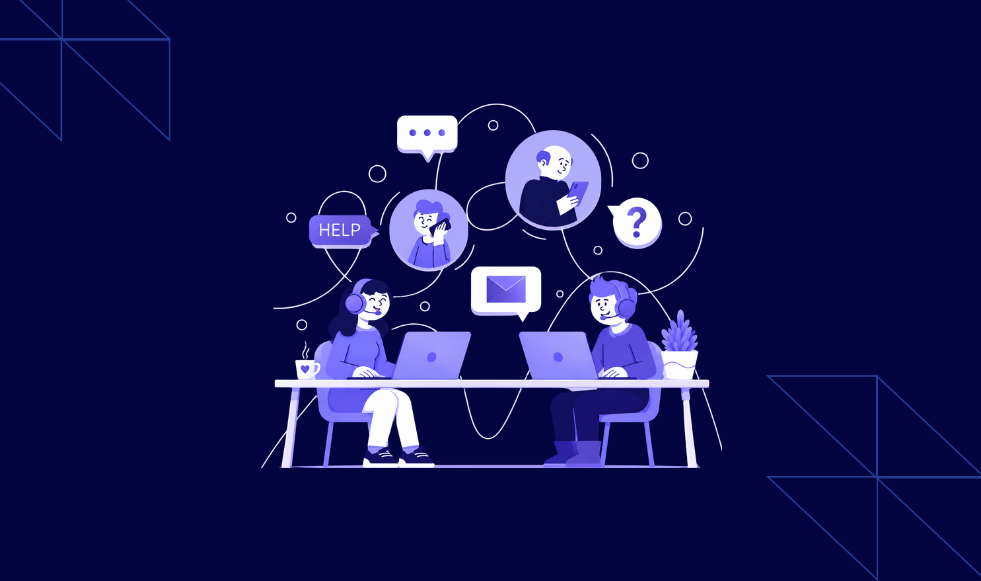
An inbound-outbound blended contact center handles customer-initiated and business-initiated calls through a coordinated team and technology stack. Agents may answer support, billing, order, technical, or product questions, then move to scheduled callbacks, post-purchase follow-ups, surveys, renewals, or qualified sales outreach when inbound volume allows.
| Model | How It Works | Best Fit |
| Separate specialists, shared management | Teams remain distinct but use common tools and reporting | Complex work requiring deep specialization |
| Partially blended team | Selected agents handle both queues | Recurring peaks and moderate complexity |
| Fully blended team | Most agents move dynamically between queues | Stable processes and strong cross-training |
| Time-blocked hybrid | Agents switch during scheduled periods | Campaigns requiring preparation or focus |
The right hybrid call center model depends on call complexity, service levels, compliance requirements, and demand patterns.
A multi-skill agent call center offers the most flexibility but also requires the most rigorous training. Inbound and outbound conversations start differently. A customer calling about a delayed order expects fast diagnosis. A customer receiving a renewal call needs context and a clear reason to engage.
Combining inbound and outbound calling works only when coaching reflects the differences between them.
How Blended Routing Works
The technology behind an inbound-outbound blended contact center generally combines automatic call distribution, interactive voice response, skills-based routing, customer records, and outbound dialing or callback tools.
When inbound demand rises, the system gives customer-initiated calls priority and slows or pauses eligible outbound work. When demand falls, qualified agents receive outbound tasks. Blended platforms can deliver both queues through one interface, reducing time spent switching between systems.
This is where blended call center outsourcing improves utilization without sacrificing service. The goal is not maximum occupancy at every moment. It is productive use of available time while response targets remain protected.
Routing should consider:
- Agent skill and certification
- Customer language or region
- Call purpose and priority
- Open-case ownership
- Campaign eligibility
- Local calling hours
- Consent records and suppression lists
- Service-level risk
A flexible call center staffing model is most useful when supervisors can see these conditions in real time. They should know when an inbound queue is approaching its threshold, when outbound work needs to pause, and whether one skill group is carrying too much demand.
At Atidiv, our inbound call center service includes smart call routing, live dashboards, speech analytics, and dynamic workforce management. We also support customer service, technical issues, order tracking, billing, and product-related inquiries. We use those capabilities to make blended call center outsourcing responsive to actual workload. Our voice support services can include inbound and outbound activities, with priorities and escalation rules tailored to your customer journey.
Where Inbound and Outbound Work Fit Together
Not every outbound campaign belongs in a blended queue. High-pressure sales campaigns, regulated collections, and complex research calls may need dedicated agents. The best candidates are tasks that can pause safely when inbound demand changes.
| Inbound Work | Related Outbound Work |
| Order-status questions | Proactive delay notifications |
| Returns support | Missing-information follow-up |
| Subscription questions | Renewal reminders or save offers |
| Technical support | Callback after troubleshooting |
| Billing inquiries | Failed-payment follow-up |
| Complaints | Service-recovery outreach |
| General support | Satisfaction surveys |
This pairing is one of the clearest blended agent model benefits. The same team sees the issues customers report and the reasons the business reaches out. That context can improve scripts, escalation rules, product feedback, and follow-up quality.
For a D2C company earning $5M+ revenue, missed outbound work can carry a real opportunity cost. Delayed payment follow-ups, abandoned callbacks, and inconsistent service-recovery calls may affect retention. Blended call center outsourcing helps preserve those activities without maintaining a separate team that may be underused outside campaigns.
A well-run inbound-outbound blended contact center can also improve continuity. When a customer returns a missed call, the agent can see the reason for the outreach and the prior account history, rather than starting over.
This matters for callbacks in particular. A customer who was promised an update should not have to repeat the issue because the return call reached a different department.
Operational Benefits
The strongest case for blended call center outsourcing is not that one agent replaces two people. That claim ignores training time, complexity, and service risk.
The value comes from sharing capacity, reducing handoffs, and more closely matching work to demand.
Better Use of Available Capacity
Inbound queues require protective capacity because customer arrivals are uncertain. Outbound work can fill part of the quieter periods when that work is safe to interrupt.
A flexible call center staffing model allows you to respond to peaks without treating every lower-volume interval as wasted time.
Faster Follow-Up
Customer promises often create outbound tasks. You may need to call back after checking with a warehouse, confirm that a replacement arrived, or follow up after a technical fix.
Combining inbound and outbound calling keeps these commitments within the same operating structure rather than sending them to a separate list that may receive attention later.
More Complete Customer Context
A multi-skill agent call center can give agents access to support history, campaign context, previous conversations, and open cases. That reduces repeated questions and makes outreach more relevant.
An agent contacting a customer about a failed subscription payment, for example, should be able to see whether that customer already called support about the issue.
Broader Agent Capability
The practical blended agent model benefits include broader product knowledge, better objection handling, faster callbacks, and a clearer view of the customer lifecycle.
Breadth should not come at the expense of competence. Agents should be certified for each queue before receiving live work.
Simpler Workforce Planning
Separate teams can create two staffing problems at once: too many people in one queue and too few in another.
Blended call center outsourcing gives workforce managers more options, particularly when inbound and outbound demand peak at different times.
For a VP, Director, or senior manager of a growing D2C company, the larger benefit is resilience. The operation can absorb a launch, campaign, or service issue without immediately creating another team.
Staffing and Training
A blended model changes the agent’s job.
Inbound work is usually reactive. The customer has a question, complaint, or problem and expects the agent to respond quickly.
Outbound work requires a different opening. The agent must earn the customer’s attention, explain the purpose of the call, confirm that it is appropriate to continue, and guide the discussion toward a defined outcome.
A multi-skill agent call center therefore needs role-based training, not one generic script. Agents may need:
- Product and policy knowledge
- Active listening
- Complaint handling
- Objection handling
- Call control
- Accurate dispositioning
- Data-security training
- Campaign-specific compliance instruction
Your hybrid call center model should include a certification path. An agent might begin with one inbound queue, add customer callbacks, then progress to retention or sales outreach after meeting quality standards.
A flexible call center staffing model also requires realistic forecasting. Inbound arrivals, average handle time, absenteeism, shrinkage, campaign volume, callback promises, and regional coverage all affect the schedule.
Blending gives workforce managers more options, but it does not remove the need for planning.
The blended agent model benefits are strongest when queue priorities are clear. If inbound service levels are at risk, outbound work should pause. When demand stabilizes, eligible campaigns can resume.
For a D2C brand operating in multiple regions like the UK, the US, and Australia, scheduling must also account for local business hours, time zones, customer expectations, and campaign rules. Blended call center outsourcing can provide wider coverage, but regional procedures should be documented rather than assumed.
Technology and Compliance
An effective inbound-outbound blended contact center needs more than phone lines.
The operating stack may include:
- Automatic call distribution
- Interactive voice response
- Skills-based routing
- Customer records and CRM integrations
- Call recording
- Outbound campaign tools
- Workforce management
- Quality assurance
- Real-time and historical reporting
The system should show agents why a call is arriving, what the customer has already done, and what outcome the business expects.
For outbound activity, combining inbound and outbound calling must be designed around applicable law and customer consent.
In the United States, the Telemarketing Sales Rule requires certain disclosures, prohibits misrepresentations, limits calling times, and requires businesses to honor applicable do-not-call requests. The Federal Trade Commission also notes that state laws and Federal Communications Commission rules may apply.
Not every outbound call is telemarketing. The FTC distinguishes purely informational messages, such as certain order-status or delivery updates, from calls that include a sales component. Mixed-purpose calls may trigger additional requirements.
A compliant hybrid call center model should maintain consent records, suppression lists, approved scripts, local calling windows, audit trails, and clear escalation paths.
Compliance should not depend on an agent remembering every rule while handling a live conversation.
At Atidiv, our outbound call center service includes consent tracking, timestamped logs, secure data handling, ongoing agent training, and alignment with TCPA and Do Not Call requirements. That control layer matters when blended call center outsourcing combines support calls with proactive outreach. Our voice support services are structured around defined use cases, customer permissions, quality checks, and reporting. Book a free consultation to learn more!
Implementation and Measurement
Start by separating work that must be answered immediately from work that can be scheduled.
Inbound service, urgent callbacks, and open escalations usually take priority. Surveys, welcome calls, and nonurgent follow-ups can be interruptible.
Next, map the skills required for each queue. A multi-skill agent call center is only flexible when the system knows which agents are qualified for each call type.
Define the switching rules. Your inbound-outbound blended contact center should specify:
- When outbound activity pauses
- Which campaigns may remain active
- Which customers should not be called
- How supervisors respond when service levels deteriorate
- Which calls require specialist handling
- How unfinished outbound work returns to the queue
Pilot blended call center outsourcing with one inbound queue and one or two related outbound use cases.
Post-purchase support and delivery follow-up, for example, are easier to combine than technical troubleshooting and cold sales.
Use recordings and quality reviews to assess whether agents change tone appropriately. Combining inbound and outbound calling should not make service calls sound like sales calls or outbound outreach sound improvised.
Measure the pilot across both sides of the operation:
| Metric | What It Reveals |
| Service level and speed of answer | Whether inbound customers receive timely support |
| Abandonment rate | Whether callers leave before reaching an agent |
| First-contact resolution | Whether issues are resolved without repeat calls |
| Outbound contact rate | Whether campaigns reach the intended audience |
| Callback completion | Whether follow-up promises are kept |
| Conversion, renewal, or save rate | Whether outbound work achieves its objective |
| Transfer rate | Whether skills and routing are aligned |
| Occupancy and schedule adherence | Whether staffing is being used as planned |
| Quality and customer satisfaction | Whether efficiency is affecting the experience |
The blended agent model benefits should appear across both inbound and outbound results. Lower idle time means little if wait times rise, callbacks are missed, or quality falls.
For blended call center outsourcing, ask for reporting by queue, campaign, skill, region, and time interval.
A mature hybrid call center model should also show why transfers occur, why callbacks fail, and which outbound campaigns create additional inbound contacts.
How Atidiv Can Help With Inbound Demands And Outbound Commitments In 2026
At Atidiv, we help you manage inbound support and outbound engagement through one coordinated operating model.
We begin by reviewing your call types, demand patterns, service targets, customer segments, and escalation requirements. This helps determine which activities can share agent capacity and which require dedicated specialists.
Our teams can support:
- Customer service and order-related inquiries
- Technical and billing support
- Scheduled callbacks
- Delivery and payment updates
- Subscription and retention outreach
- Post-purchase follow-ups
- Customer surveys and lead qualification
Inbound demand remains the priority. When call volumes rise, eligible outbound activity can be paused or reassigned. During quieter periods, trained agents can complete callbacks, follow-ups, and approved outreach without leaving available capacity unused
We also establish clear skill requirements before agents move between queues. Agents receive training on your products, policies, systems, scripts, and escalation paths, followed by ongoing call monitoring and quality reviews.
Our reporting helps you track inbound service levels, callback completion, customer satisfaction, outbound outcomes, transfer rates, and quality performance. This gives your team a practical view of whether the blended model is improving efficiency without affecting customer experience.
Depending on your needs, we can support a partially blended team, a scheduled hybrid structure, or a wider multi-skilled operation. The model is built around your call complexity and customer needs rather than forcing every interaction into the same queue.
Talk to us about the inbound demand, outbound commitments, and staffing gaps you need to manage.
Related guide: Difference Between Inbound vs. Outbound Calls: A Comprehensive Guide and Applications
Blended Call Center Outsourcing FAQs
1. What is blended call center outsourcing?
Blended call center outsourcing uses an external team to handle coordinated inbound and outbound calling. Agents move between support, callbacks, surveys, retention, and approved sales activity according to skills, demand, and queue priorities.
2. How does an inbound-outbound blended contact center work?
An inbound-outbound blended contact center prioritizes customer-initiated calls when demand rises, then assigns eligible outbound work when capacity becomes available.
3. What are the main blended agent model benefits?
The main blended agent model benefits include better capacity utilization, faster callbacks, fewer handoffs, broader agent capabilities, and closer coordination between reactive support and proactive outreach.
4. Is a multi-skill agent call center suitable for every campaign?
No. A multi-skill agent call center works best when agents can be trained across related queues. Complex sales, regulated collections, or highly technical work may still require dedicated specialists.
5. How does a flexible call center staffing model handle peaks?
A flexible call center staffing model prioritizes inbound demand, pauses interruptible outbound work, uses cross-trained agents, and retains overflow or specialist coverage during unusually busy periods.
6. What should you check before combining inbound and outbound calling?
Before combining inbound and outbound calling, review queue priorities, agent training, customer consent, calling windows, suppression lists, scripts, technology, reporting, and the legal requirements that apply to each campaign.
